

Last Updated: October 22, 2026
Quick Summary
To choose non-toxic skincare, match ingredients to your skin type and sensitivities first, then read the full ingredient list on the back of the package rather than trusting front-label claims. Since "non-toxic" has no legal definition, check the first five ingredients, flag anything your skin has reacted to, and patch test every new product before use.
- Ingredients are listed in descending order of concentration, so the first five make up most of the formula.
- Keep a personal avoid-list of ingredients your skin has reacted to and check it against full labels.
- Patch test new products on your inner forearm or behind your ear for 24 to 48 hours.
- Exfoliate two or three times a week, not daily, and moisturize every day even if you're oily.
- Certifications confirm a specific standard was met but do not prove a product is safe for your skin.
Table of Contents
- Start With Your Skin, Not the Label
- How to Read Skincare Ingredient Labels
- Non-Toxic Skincare Ingredients to Look For and Avoid
- Build a Non-Toxic Skincare Routine That Fits Your Life
- Natural Skincare for Sensitive Skin: Patch Test First
- Evaluate Claims, Certifications, and Price
- Conclusion
- Frequently Asked Questions
Start With Your Skin, Not the Label
The best way to choose non-toxic skincare is to match ingredients to your skin type and sensitivities first, then judge the label second. A product marketed as "clean" can still irritate dry, acne-prone, or sensitive skin. Your skin is the deciding factor, not the sticker.
According to Market.us skincare statistics, 59% of U.S. survey respondents said they prefer skincare made with natural or organic ingredients. That preference is a starting point, not a finish line. At Mad Penguin Skincare, we prioritize clean formulas, free from synthetic chemicals and harsh additives, to support healthy, hydrated, and nourished skin naturally.
Here's the honest part most guides skip. "Non-toxic" has no legal definition. So the label tells you very little on its own.
Start with three questions:
- What is my skin type (dry, oily, combination, sensitive)?
- What has irritated my skin before?
- What do I actually need (hydration, exfoliation, anti-aging)?
Answer those, and the rest of this guide gets much easier.
How to Read Skincare Ingredient Labels
Reading a skincare ingredient label means scanning the full list on the back of the package, not the front of the bottle, and knowing that ingredients appear in descending order of concentration. The first five ingredients typically make up the bulk of the formula, so start there, but do not stop there.
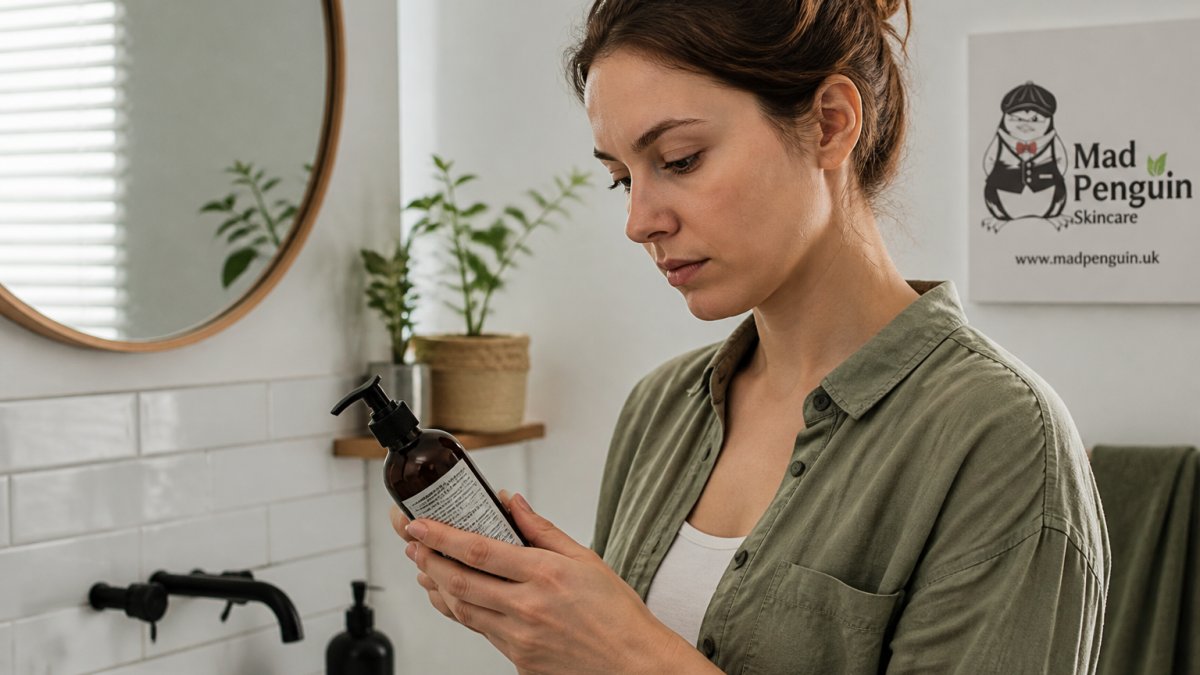
Most guides tell you to avoid certain names. Fewer give you a repeatable method. Here is a five-step label-check workflow to evaluate any product.
Step 1: Confirm the product type and your goal. A leave-on serum and a rinse-off cleanser carry different exposure profiles. Write down what you need the product to do (hydrate, exfoliate, soothe) before you judge any ingredient.
Step 2: Read the first five ingredients. These carry most of the formula. Look for water or aloe near the top to understand the base, and note whether the hero ingredients you saw on the front label actually appear early in the list or only in trace amounts near the end.
Step 3: Scan for your personal red flags. Fragrance, dyes, and strong preservatives are common irritants for sensitive skin. If you have reacted to a specific ingredient before, search the full list for it rather than trusting a "free-from" claim on the front.
Step 4: Check the full list for completeness. A label that lists only "key ingredients" or "active ingredients" without a full ingredient declaration is a transparency problem. Full-label disclosure is one of the clearest signals of a brand standard you can actually evaluate.
Step 5: Cross-check claims against the list. If a product claims to be fragrance-free, the list should not include parfum or fragrance. If it claims to be preservative-free, ask how the formula stays stable. Mismatches between front-label claims and back-label reality are a reason to slow down.
A 2024 review in the NCBI cosmetics health-risk analysis reported that 88 chemicals across more than 73,000 cosmetic products had been flagged as toxins linked to effects like headaches, dizziness, and skin irritation. That is a big number, and it is a reason to read labels carefully.
The takeaway: read the whole list, understand the top five, flag anything you know your skin reacts to, and treat front-label claims as marketing until the back label confirms them. If you want to practice on a formula built for transparency, our California Ocean Mineral Anti-Aging Moisturizer lists its full ingredients so you can run this workflow start to finish.
Non-Toxic Skincare Ingredients to Look For and Avoid
There's no official "banned" list, so treat this as a personal filter. Look for gentle, recognizable ingredients and limit the ones linked to irritation for your skin type.
Ingredients worth seeking out:
- Plant-based oils and butters for hydration
- Antioxidants like hibiscus and vitamin C for brightness
- Aloe and glycerin for gentle moisture
- Mineral-based formulas for sensitive skin
Ingredients to scrutinize:
- Synthetic fragrance, a frequent trigger for sensitive skin
- Parabens, which many shoppers choose to avoid
- Harsh sulfates that can strip the skin barrier
- Dyes and strong preservatives if your skin reacts easily
Our California Ocean Mineral Anti-Aging Moisturizer is built around ocean minerals and a gentle formula free from unnecessary harsh chemicals. It's designed to hydrate dry, mature skin without the irritation many stronger products cause.
The key point: avoid ingredients you know bother your skin, not just ingredients with scary names online.
Build a Non-Toxic Skincare Routine That Fits Your Life
A non-toxic skincare routine is a simple, repeatable set of steps you'll actually keep up: cleanse, treat, moisturize, and protect. Skip the ten-step hype. Consistency beats complexity.
A routine that works for most skin types:
- Cleanse gently, morning and night.
- Exfoliate two or three times a week, not daily.
- Moisturize every day, even if you're oily.
- Use an eye cream if puffiness or fine lines bother you.
- Protect with sunscreen in the morning.
If you want a shortcut, our Hydrating Skin Starter Kit pairs the Hibiscus Scrub with the Ocean Mineral Moisturizer for $48. It covers cleanse and moisturize in two steps.

Natural Skincare for Sensitive Skin: Patch Test First
Natural skincare for sensitive skin still needs a patch test, because "natural" does not mean "hypoallergenic." Plant extracts and essential oils can trigger reactions just as easily as synthetic ingredients.
How to patch test:
- Apply a small amount to your inner forearm or behind your ear.
- Wait 24 to 48 hours.
- Watch for redness, itching, or bumps.
- If nothing happens, try it on a small area of your face first.
This matters more than any label claim. A product can be clean, natural, and still wrong for your skin. Patch testing is the cheapest insurance you have.
If you have a known condition like eczema or rosacea, talk to a dermatologist before adding actives.
Evaluate Claims, Certifications, and Price
Certifications and price tags are useful signals, but neither proves a product is safe or effective for you. Use them as filters, not verdicts. The stronger skill is knowing what each claim actually covers, what it leaves out, and how to judge value without equating a higher price with a better formula.
What certifications can and cannot tell you. Third-party seals confirm that a brand met a specific standard set by the certifying body. That is useful, but the scope varies widely. One standard may focus on a short exclusion list, another on sourcing or manufacturing, and another on animal testing. A seal does not mean every ingredient has been reviewed for your skin type, and it does not replace a patch test.
What "clean," "natural," and "organic" mean on a label. These terms are not defined by federal regulation for cosmetics in the same way that organic food claims are. "Natural" is a marketing term, not a safety guarantee, and plant extracts and essential oils can trigger reactions just as easily as synthetic ingredients.
Regulatory context and the limits of safety databases. Cosmetic oversight in the United States relies on a mix of federal law, FDA enforcement, and industry self-regulation, and the FDA does not pre-approve every cosmetic product or ingredient before it reaches shelves. That is why independent databases and ingredient flags are useful starting points but not definitive product-safety verdicts.
How to judge price fairly. A higher price does not guarantee a better formula. Some of the biggest markups come from packaging and marketing, not ingredients. Budget-friendly products can be perfectly good, and expensive ones can still irritate your skin. Compare cost per ounce, check the return policy, and weigh the full ingredient list and certifications against what you actually need.
| What to check | Why it matters |
|---|---|
| Full ingredient list | Shows what is actually in the formula |
| Certification scope | Confirms a specific standard was met, not full safety |
| Front-label claims | Marketing until the back label confirms them |
| Price per ounce | Compares cost fairly across sizes |
| Return policy | Lets you try without full risk |
As Harvard Health's guidance on cosmetic chemicals notes, the most reliable step is checking the label yourself and deciding what you are comfortable using. That is the same principle we apply at Mad Penguin Skincare: publish the full formula, explain what the product is for, and let you evaluate it against your own skin.
Our Healthy Skin Routine bundles four products for $96, which brings the per-product cost down compared with buying each one alone. If you prefer to start smaller, the Hydrating Skin Starter Kit pairs the Hibiscus Scrub with the Ocean Mineral Moisturizer for $48. Either way, you can read the full ingredient list on each product page and run the label-check workflow above before you buy.

Conclusion
Choosing non-toxic skincare comes down to your skin, not the label. Read the full ingredient list, patch test anything new, and judge certifications and price as filters rather than proof.
At Mad Penguin Skincare, we build clean formulas free from synthetic chemicals and harsh additives, made for all skin types with eco-friendly packaging. Our natural, non-toxic products are designed to hydrate and nourish without compromise.
Ready to build a routine that fits your skin? Shop Mad Penguin Skincare and start with products that deliver powerful, effective results.
Frequently Asked Questions
Are natural skincare products always safer?
No. Natural and organic labels do not guarantee safety. A 2024 review found 88 chemicals in more than 73,000 cosmetic products had been linked to effects like headaches, dizziness, and skin irritation, and some of those ingredients occur in plant-based form. A U.S. survey found 59% of respondents preferred natural or organic ingredients, but preference is not proof of safety. Check the full ingredient list and patch test any new product, especially if you have sensitive skin.
How can I tell if skincare ingredients are safe?
Read the full ingredient list rather than the front label. Look up unfamiliar names in a public ingredient database, and note whether the product lists fragrance or parfum, which can hide multiple compounds. Harvard Health recommends checking what chemicals a product contains and deciding whether you want to use it. If you have sensitive or acne-prone skin, patch test on your inner forearm for 24 to 48 hours before applying to your face.
What is a good non-toxic skincare routine?
Keep it simple: a gentle cleanser, a treatment or serum if you need one, a moisturizer, and sunscreen in the morning. Mad Penguin Skincare offers a Hydrating Skin Starter Kit ($48.00) with a hibiscus scrub and ocean mineral moisturizer, or a Healthy Skin Routine ($96.00) that adds an eye cream and night cream. Introduce one new product at a time and give it two to four weeks before judging results.
How do I choose skincare for sensitive skin?
Start with fewer products and fewer ingredients. Avoid synthetic fragrance and drying alcohols, and patch test every new item. For sensitive skin, a fragrance-free moisturizer like Mad Penguin's California Ocean Mineral Anti-Aging Moisturizer ($33.00) is a reasonable first step. If a product stings or turns your skin red, stop using it and return to a routine you know works before trying something else.