
Table of Contents
- What Greenwashing in Skincare Actually Looks Like
- The Seven Sins of Greenwashing, Translated for Beauty
- FDA Skincare Labeling Regulations: What Brands Can and Cannot Claim
- How to Read Skincare Ingredient Labels Without Getting Fooled
- Third-Party Beauty Certifications That Actually Verify Claims
- Greenwashing Examples in Beauty: Real Claims That Fell Apart
- The Greenwashing vs. Cost Paradox: Why Clean Formulas Cost More
- Post-Purchase Verification: Checking a Brand After You Buy
- Conclusion
- Frequently Asked Questions
Last Updated: September 11, 2026
What Greenwashing in Skincare Actually Looks Like
Greenwashing in skincare makes a product appear more natural, sustainable, or environmentally responsible than it is. Greenwashing in skincare often manifests as a leaf icon, the word "pure" in green script, and an ingredient list that opens with water and closes with synthetic fragrance.
Greenwashing lives in the gap between marketing and formula. Learning how to identify greenwashing in skincare comes down to one habit: reading past the front of the package to the back.
Brands spend heavily on eco-friendly marketing because it sells, but front-label claims face far looser rules than the ingredient list on the back.
Below, we'll show you how to identify greenwashing in skincare using a comprehensive checklist, plus the regulatory context most guides skip.
The Seven Sins of Greenwashing, Translated for Beauty
TerraChoice's "Seven Sins of Greenwashing" framework remains the most useful lens for spotting misleading imagery and packaging. Translated to skincare, the sins look like this:
- Sin of the hidden trade-off - A bottle labeled "plant-based" that ships in non-recyclable mixed-material packaging.
- Sin of no proof - "Cruelty-free" with no certification body named anywhere on the label or website.
- Sin of vagueness - "Clean," "green," and "pure" mean nothing legally in skincare.
- Sin of irrelevance - "No parabens" on a product that never needed parabens.
- Sin of lesser of two evils - "Organic" claims on a category where organic certification barely exists.
- Sin of fibbing - Claims that are simply false, like a "vegan" product containing beeswax.
- Sin of worshipping false labels - A brand-created seal designed to look like an independent certification.
FDA Skincare Labeling Regulations: What Brands Can and Cannot Claim
Most consumer guides wave at 'the FDA' and move on. Knowing the actual regulatory architecture separates a shopper who spots greenwashing from one who just feels suspicious.
The FDA regulates cosmetic labeling under the Federal Food, Drug, and Cosmetic Act (FD&C Act) and the Fair Packaging and Labeling Act. A cosmetic is defined by its intended use, cleansing, beautifying, promoting attractiveness, or altering appearance. A drug is defined by its intended use too: diagnosing, curing, mitigating, treating, or preventing disease, or affecting the structure or function of the body.
That distinction matters because the same bottle can be one or the other depending on what the label promises. A moisturizer that says 'hydrates dry skin' is a cosmetic; the same moisturizer that says 'repairs the skin barrier' or 'treats eczema' makes a structure/function or drug claim, triggering a different substantiation standard. Brands know this, which is why so many hover in the cosmetic lane and let imagery do the work the copy can't legally do.
What the FDA Actually Says About 'Natural' and 'Organic'
The FDA has not established a regulatory definition for 'natural' in cosmetics (the FDA). Its informal guidance treats 'natural' as an ingredient's source, not its processing, so a naturally derived ingredient that has been heavily chemically modified could still be called natural. That is far narrower than most shoppers assume.
The FDA also does not regulate 'organic' in cosmetics the way the USDA regulates it for food. The USDA's National Organic Program (NOP) covers agricultural products; cosmetics with agricultural ingredients can pursue USDA organic certification, but mostly synthetic ones cannot. That's why 'made with organic ingredients' is common and a full USDA seal is rare.
Where the FTC Comes In
The Federal Trade Commission polices advertising claims, including environmental marketing, under Section 5 of the FTC Act, which prohibits unfair or deceptive acts or practices (the FTC). The FTC's Green Guides lay out how marketers should phrase and substantiate environmental claims. They are administrative guidance, not a statute, but the FTC has brought enforcement actions against companies whose claims ran afoul of them, and state attorneys general can act on similar theories.
A few Green Guides principles translate directly to skincare:
- Broad, unqualified claims need strong substantiation. 'Eco-friendly' or 'sustainable' with no qualifier is exactly the kind of claim the FTC warns against.
- Overstatement is deceptive. A product that is 10% recycled content cannot be marketed as if the whole package is recycled.
- Comparative claims need a basis. 'Greener than' requires a defined comparison.
- Certifications and seals must be meaningful. A brand-created seal that implies independent verification the brand did not receive is a classic deceptive practice.
The State Layer Most Guides Skip
A handful of states have moved on cosmetic ingredient disclosure in ways federal law has not. California's Cosmetic Fragrance and Flavor Ingredient Right to Know Act requires disclosure of certain fragrance allergens and other ingredients of concern, and Proposition 65 requires warnings for listed chemicals. Several states have passed or proposed laws restricting PFAS in cosmetics. None define 'clean,' but they create disclosure obligations a greenwashed label often fails to satisfy, a concrete, checkable signal.
The Practical Takeaway
When you see 'natural,' 'clean,' 'pure,' 'non-toxic,' or 'eco-friendly' on a skincare label, you are reading marketing copy, not a regulated claim. The FDA has no definition for 'natural' in cosmetics, the USDA organic standard does not automatically apply, and 'clean' has no legal meaning at all. The FTC does require environmental claims to be truthful, not misleading, and substantiated. If a brand cannot point to the substantiation, the claim is decorative.
How to Read Skincare Ingredient Labels Without Getting Fooled
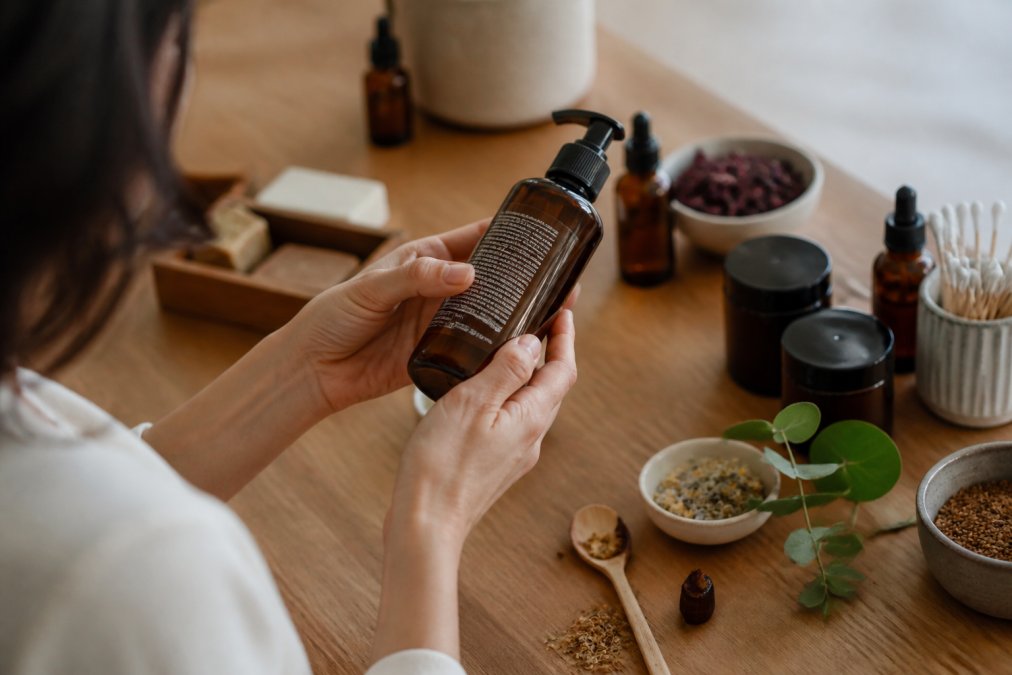
Ingredient lists are ordered by concentration, from highest to lowest (ecfr.gov). If the "hero" botanical a brand built its campaign around appears after the preservative, it's present in trace amounts.
Three things to check, in order:
- The first five ingredients. These make up the bulk of the formula. If water, glycerin, and a synthetic emollient dominate, the product is not a "botanical blend."
- The INCI names. "Aqua" is water. "Parfum" or "fragrance" is an undisclosed mixture that can contain dozens of compounds.
- The tail end. Preservatives, fragrance, and colorants live here. That's normal. What matters is whether the front label pretends they aren't there.
Red Flags in the First Five Ingredients
A common mistake is trusting front-of-bottle claims over the first five ingredients. If a brand markets itself as fragrance-free but "parfum" sits in the top five, that's a contradiction you can verify in ten seconds.
Third-Party Beauty Certifications That Actually Verify Claims
A certification is only as strong as the audit behind it. The table below covers the seals you'll actually see on skincare, what each verifies, and what it does not.
| Certification | What It Verifies | Who Issues It | What It Does NOT Cover |
|---|---|---|---|
| USDA Organic | Organic agricultural content per NOP standards | USDA-accredited certifiers | Synthetic ingredients, packaging, labor practices |
| Leaping Bunny | No animal testing at any point in the supply chain | Cruelty Free International | Ingredient sourcing, environmental impact |
| B Corp | Social and environmental performance across the whole company | B Lab | Individual product formulas |
| COSMOS | Organic and natural cosmetics standards (COSMOS ORGANIC / COSMOS NATURAL tiers) | COSMOS-standard AISBL | Packaging recyclability, carbon footprint |
| EWG Verified | Ingredient safety screening against EWG's own criteria | Environmental Working Group | Sustainability, sourcing, ethics |
| NSF / NPA Natural | Natural ingredient standards for personal care | NSF International / Natural Products Association | Efficacy, environmental claims |
Two rules apply. First, a logo means nothing unless you can name the issuing body and find its public standard. Second, certifications cover specific claims, not the whole product. A cruelty-free seal says nothing about biodegradability, and a B Corp score says nothing about whether the formula in your hand is 'clean.'
How to Verify a Certification in Under Five Minutes
Every credible certifier maintains a public registry, and checking it takes less time than reading the product page.
- Leaping Bunny: Cruelty Free International publishes a searchable company database. If the brand is not listed, the bunny logo is decorative.
- B Corp: B Lab's directory lists every certified company with its current score and certification date. Scores are public and comparable.
- USDA Organic: The USDA Organic Integrity Database lets you search certified operations by name. A 'made with organic ingredients' claim is not the same as the USDA seal.
- COSMOS: COSMOS-standard publishes a certified products and brands list. The tier matters, COSMOS ORGANIC requires a minimum organic content threshold that COSMOS NATURAL does not.
- EWG Verified: EWG maintains a searchable verified products database. Note that EWG Verified is EWG's own standard, not a government one.
If a brand displays a seal and you cannot find it in the issuing body's registry within a few minutes, that is your answer.
Supply Chain Traceability: The Tools That Go Deeper Than Seals
Certifications verify a claim at a point in time. Traceability tools let you follow ingredients upstream, where the real greenwashing tends to hide.
- Supplier disclosure lists. A growing number of brands publish their raw material suppliers or at least their major ingredient categories. A brand that publishes this is inviting scrutiny; one that does not is asking you to trust.
- Ingredient databases. The International Nomenclature of Cosmetic Ingredients (INCI) system gives every ingredient a standardized name, which lets you cross-reference a formula against public safety and sourcing databases rather than relying on the front label.
- Palm oil and deforestation tools. The Roundtable on Sustainable Palm Oil (RSPO) maintains a public member and certification lookup. If a brand claims sustainable palm, you can check whether it or its suppliers appear.
- Conflict mineral and mica sourcing. Mica is common in cosmetics and has well-documented supply chain risks. Some brands publish mica sourcing statements; the Responsible Mica Initiative maintains member lists.
- Packaging claims. How2Recycle labels are standardized and searchable by material. A 'recyclable' claim on a mixed-material pump often fails the How2Recycle test.
The Scope Trap
The most common greenwashing move with certifications is scope inflation, using a narrow certification to imply a broad one. A product certified COSMOS NATURAL is not the same as one certified COSMOS ORGANIC. A company with a B Corp score is not necessarily selling a B Corp product. A Leaping Bunny seal says nothing about whether the formula contains petroleum-derived ingredients.
When you see a seal, read the standard behind it, then ask what the seal does not cover. That gap is where the marketing lives.
Greenwashing Examples in Beauty: Real Claims That Fell Apart
The pattern shows up across the industry, usually following the same script: a brand builds its identity on a single claim, a journalist or regulator investigates, and the claim quietly disappears from the packaging.
Common greenwashing examples in beauty include "chemical-free" products (impossible, since water is a chemical), "non-toxic" claims with no toxicology data, and "sustainable" packaging that turns out to be virgin plastic with a green tint. In each case, the marketing outran the substantiation.
The lesson isn't that all clean beauty claims are false. It's that unregulated buzzwords do the heavy lifting precisely because no one has to prove them.
The Greenwashing vs. Cost Paradox: Why Clean Formulas Cost More
Clean formulas genuinely cost more to make. Natural preservatives have shorter shelf lives and narrower pH tolerances than synthetic ones, ethically sourced raw materials cost more per kilogram, and small-batch manufacturing and recyclable or compostable packaging carry real premiums.
That creates a paradox: the brands most likely to make honest sustainability claims are often the ones charging more, which makes shoppers suspicious. Meanwhile, a mass-market product can slap a green label on a cheap formula and undercut everyone.
So price alone tells you nothing. What matters is whether the higher cost is explained. A brand that can tell you which ingredient is expensive and why is usually telling the truth.
Post-Purchase Verification: Checking a Brand After You Buy
Verification doesn't stop at checkout. The most reliable sustainability claims are the ones you can audit after the product is in your bathroom.
Four steps to run on any brand you've already bought from:
- Check the certification registry. Leaping Bunny and B Corp both publish searchable databases. If the brand isn't listed, the logo was decorative.
- Read the sustainability report. Look for specific numbers on carbon footprint, water use, and packaging composition, not adjectives.
- Trace the supply chain. Increasingly, brands publish supplier lists or use traceability platforms that let you see where raw materials originate.
- Watch for claim changes. If a sustainability claim vanishes from a product page between restocks, that's a signal worth noting.
Conclusion
Greenwashing is designed to be hard to spot, and it works because the rules governing front-label claims are far weaker than the ones governing the formula itself. Mad Penguin Skincare prioritizes natural, non-toxic ingredients, clean formulas free from synthetic chemicals and harsh additives, and eco-friendly, responsibly made products that work across all skin types. If you want skincare where the ingredient list matches the promise on the front, explore the Mad Penguin Skincare range and see the difference transparency makes.
Frequently Asked Questions
How can I tell if a skincare brand is greenwashing?
Look for vague terms like 'natural' or 'eco-friendly' without proof, check whether certifications come from independent bodies, and scan the ingredient list for synthetic fragrances or preservatives hiding behind plant-sounding names. If a brand claims to be 'chemical-free' but lists water and preservatives, that is a contradiction. Cross-check claims against the FDA skincare labeling regulations, which prohibit drug-like claims on cosmetics without approval.
Are 'natural' and 'organic' labels regulated by the FDA?
The FDA does not define or regulate 'natural' or 'organic' on cosmetic labels the way it does for food. 'Organic' claims on skincare fall under USDA agricultural rules only if they meet the National Organic Program standards, which most cosmetics do not. This means a brand can print 'natural' on a bottle with no legal consequence, which is why third-party beauty certifications carry more weight than front-label wording.
Why is third-party certification important for skincare?
Independent certifications verify what a brand claims rather than letting it self-certify. Programs like USDA Organic, Leaping Bunny, and EWG Verified require documentation, audits, or ingredient screening before a product earns the seal. A certification logo is harder to fake than a marketing phrase, so it gives you a faster way to separate verified claims from unregulated buzzwords on the packaging.
What are the most common deceptive marketing terms in beauty?
Terms like 'chemical-free,' 'non-toxic,' 'clean,' 'green,' and 'eco-friendly' appear constantly on skincare packaging but have no legal definition for cosmetics. 'Dermatologist-tested' only means a dermatologist was involved somewhere in testing, not that the product passed a safety standard. 'Cruelty-free' is unregulated unless backed by a certification. Treat any of these phrases as a prompt to check the ingredient list and look for independent verification.
This article is for informational purposes only and is not medical advice. Patch test new products and consult a dermatologist for persistent skin concerns.