

Table of Contents
- Understanding Irritated Facial Skin: Causes and Triggers
- Step 1: Stop the Damage, What to Avoid Immediately
- Step 2: What to Put on Irritated Skin on Your Face
- Step 3: Build a Gentle Skincare Routine for Sensitive Skin
- How Long Does Facial Skin Irritation Last?
- Step 4: Restore Hydration and Strengthen Your Barrier
- Step 5: Reintroduce Active Ingredients Safely
- Frequently Asked Questions
Last Updated: October 11, 2026
Understanding Irritated Facial Skin: Causes and Triggers
Irritated facial skin is your body's way of signaling that something has disrupted your skin barrier. At Mad Penguin Skincare, we know that to soothe irritated facial skin starts with understanding what caused it in the first place. When your skin barrier weakens, moisture escapes and irritants penetrate deeper, creating redness, itching, and discomfort that can last days or weeks if left untreated.
The good news: most irritation responds quickly to the right approach. But first, you need to identify what triggered it.
Common triggers that damage your skin barrier
Your skin barrier is a protective layer that keeps moisture in and irritants out. When it breaks down, irritation follows. Common culprits include:
- Hot water and harsh cleansing, strips away natural oils your skin needs
- Over-exfoliation, physical scrubs or chemical exfoliants used too frequently damage the barrier
- Fragrance and essential oils, even natural ones can trigger sensitivity in compromised skin
- Sulfates and synthetic detergents, found in many mainstream cleansers, these strip and irritate
- Sudden product changes, introducing multiple new products at once overwhelms sensitive skin
- Environmental factors, cold, dry air, pollution, or chlorine exposure
- Stress and lack of sleep, weakens your skin's natural defenses
- Certain active ingredients, retinoids, vitamin C, and acids can irritate if your barrier is already compromised
How to identify your personal irritation trigger
Not every trigger affects everyone equally. Your job is to pinpoint yours.
Start by asking yourself: What changed in the last 48-72 hours before irritation appeared? Did you try a new product? Switch to hotter showers? Spend time outdoors?
Write down what you used and when. If irritation develops after introducing one product, that's likely your culprit.
Pay attention to texture, location, and timing. Does irritation appear only where you applied a specific product? Does it worsen at night or after cleansing?
Step 1: Stop the Damage, What to Avoid Immediately
The first rule of soothing irritated skin is simple: stop doing what's causing the irritation.
Remove the offending product immediately. If you're unsure which one, pause everything except a gentle cleanser and basic moisturizer for 3-5 days. This gives your skin a chance to recover without new stressors.
Avoid these habits while your skin heals:
- Hot water, use lukewarm water only; hot water strips away protective oils
- Physical scrubbing, skip exfoliants, washcloths, and rough towels; pat skin dry gently instead
- Fragrance, avoid scented products, perfumes, and essential oils (even "natural" ones can irritate)
- Active ingredients, pause retinoids, vitamin C, acids, and other potent actives until your barrier recovers
- Touching or picking, your hands introduce bacteria and worsen inflammation
- Makeup, give your skin a break if possible; if you must wear it, use only clean, gentle formulas
- Tight clothing or occlusive fabrics, let your face breathe; avoid tight masks or scarves
This pause period is not weakness, it's strategy. Your skin heals faster when you stop introducing new stressors.
Step 2: What to Put on Irritated Skin on Your Face
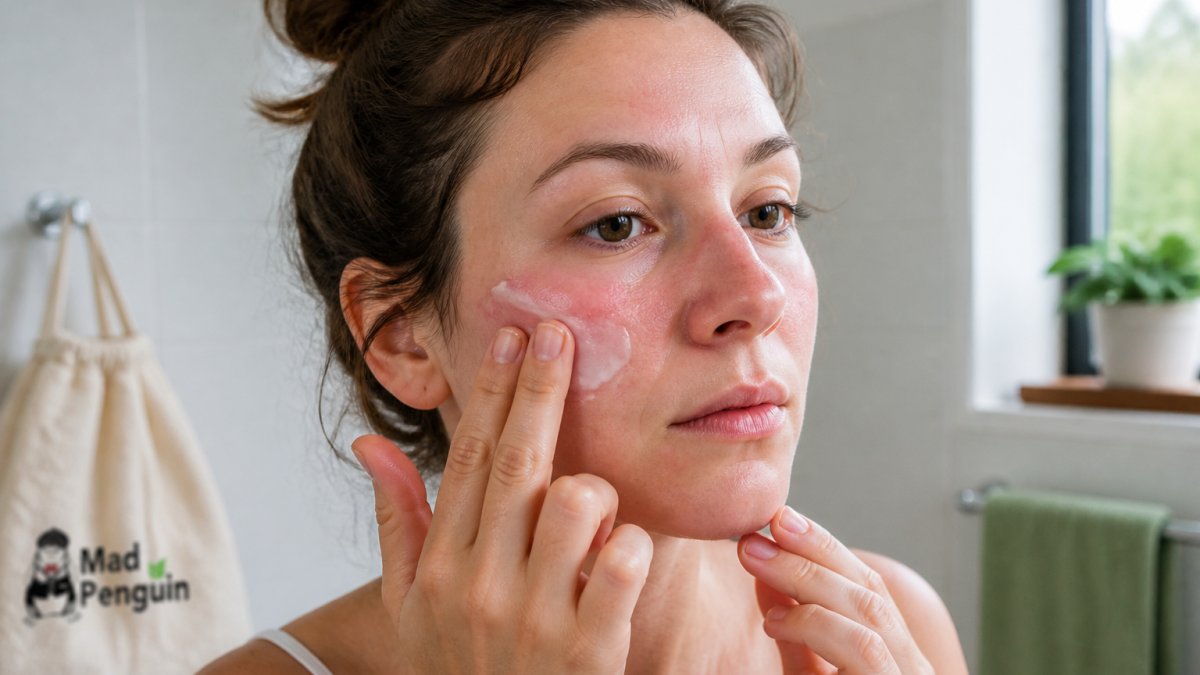
Once you've stopped the damage, it's time to actively soothe irritated facial skin. The right products calm inflammation, restore hydration, and rebuild your skin barrier.
Soothing ingredients that work
Look for products with these proven calming ingredients:
- Allantoin, reduces redness and supports barrier repair; gentle and non-irritating
- Niacinamide, strengthens the barrier, reduces inflammation, and balances oil production
- Hyaluronic acid, holds moisture in the skin; hydrates without heaviness
- Aloe vera, cools irritation and provides light hydration
- Licorice extract, calms redness and has mild anti-inflammatory properties
- Ceramides, repair the skin barrier by filling gaps between skin cells
- Glycerin, humectant that draws moisture into the skin
At Mad Penguin Skincare, we formulate with these ingredients because they work without unnecessary chemicals or fragrances that trigger sensitivity. Our California Ocean Mineral Anti-Aging Moisturizer combines hydrating ocean minerals with a gentle formula designed to support barrier repair, exactly what irritated skin needs.

How to patch test before full application
Before applying any new product to irritated skin, patch test it first.
Apply a small amount (about the size of a pea) to a discreet area like your inner arm or behind your ear. Wait 24-48 hours and monitor for redness, itching, or any reaction.
When you do apply it to your face, start with just a small amount. Use it once daily for 3-4 days before increasing frequency. This slow introduction lets your skin adjust without overwhelming it.
Step 3: Build a Gentle Skincare Routine for Sensitive Skin
A gentle routine for sensitive skin has three non-negotiable steps: cleanse, treat, and moisturize. Nothing more.
Cleansing without causing more irritation
Your cleanser should remove dirt and oil without stripping your skin.
Use lukewarm water, never hot. Choose a gentle, fragrance-free cleanser that doesn't foam heavily or leave your skin feeling tight. Massage it gently with your fingertips for 20-30 seconds, then rinse thoroughly.
Pat your skin dry with a soft towel. Don't rub. Rubbing irritates already-sensitive skin further.
If you're using a physical exfoliant like our L.A. Hibiscus natural face scrub, reserve it for when your skin has fully recovered.
Moisturizing to repair your skin barrier
Moisturizing is not optional when your skin is irritated, it's essential.
Apply moisturizer to damp skin within 60 seconds of cleansing. Damp skin absorbs products better. Use upward strokes and focus on areas that feel driest.
Choose a moisturizer rich enough to repair your barrier but not so heavy it feels suffocating. Our Hydrating Skin Starter Kit includes everything you need: a gentle cleanser and a nourishing moisturizer designed to calm and hydrate irritated skin together.

At night, consider using a richer formula. Our Night's Best Friend Overnight Repair Cream provides intensive barrier support while you sleep, exactly when your skin does most of its repair work.

How Long Does Facial Skin Irritation Last?
Understanding the timeline and knowing what to expect, and what to watch for, helps you stay patient and recognize when something isn't working.
Expected recovery timeline and what improvement looks like
Most mild to moderate irritation improves within 3-7 days once you've removed the trigger and started soothing your skin. Here's what that progression typically looks like:
Days 1-2: Acute phase Redness and discomfort peak. Your skin may feel hot, tight, or itchy. This is normal, inflammation is at its worst before it improves. Stick to your pause routine (gentle cleanser and moisturizer only). Do not introduce new products yet.
Days 3-5: Early improvement Redness begins to fade, starting at the center of the irritated area and moving outward. Itching may decrease.
Days 6-10: Visible healing Redness has noticeably diminished. Skin texture normalizes. Itching resolves. Dryness may persist but feels less severe.
Days 11-21: Full recovery Skin returns to baseline. Redness is gone. Texture is smooth. Barrier function is restored.
More stubborn irritation, especially from over-exfoliation, retinoid reactions, or post-procedure sensitivity, may take 2-4 weeks to fully resolve.
Common reason recovery stalls: People introduce new products too early, thinking they'll speed healing. At Mad Penguin Skincare, our Hydrating Skin Starter Kit is designed as a complete, minimal routine so you're not tempted to add extra steps during recovery.
How to track progress objectively
Don't rely on how your skin feels, use visual and tactile markers to confirm healing:
Visual tracking
- Take a photo of the irritated area in natural light on Day 1, then every 2-3 days. Compare them side by side. You'll often see improvement in photos before you notice it in the mirror.
- Note the color: Is redness fading from bright red to pink to normal skin tone?
- Observe the extent: Is the irritated area shrinking, or is it still spreading?
Tactile tracking
- Gently run your fingertip across the irritated area. Does it feel smoother? Less bumpy or scaly? Improving texture is a sign the barrier is repairing.
- Does the area still feel hot to the touch, or has warmth subsided?
Symptom tracking
- Rate itching on a scale of 1-10 each morning and evening. Declining scores indicate healing.
- Note tightness: Does your skin feel less tight after moisturizing?
- Track dryness: Is flaking decreasing?
Warning signs that irritation is worsening, not improving
If you notice any of these, your current approach isn't working. Stop and reassess:
- Spreading: Irritation moves to new areas of your face or body. This suggests the trigger is still present or you're introducing a new irritant.
- Increasing redness or warmth: Instead of fading, redness intensifies or the area feels hotter. This may indicate an allergic reaction or infection.
- Swelling or puffiness: Mild swelling can occur early, but worsening swelling, especially around the eyes or lips, is a red flag.
- Blistering, oozing, or open sores: These are signs of severe irritation or possible infection and require professional evaluation.
- Pain instead of discomfort: Mild itching or tightness is normal; sharp pain or burning that doesn't improve with soothing products is not.
- No improvement after 7 days: If you've removed the trigger and followed a gentle routine for a full week with zero improvement, something else is driving the irritation.
- Improvement, then sudden flare-up: If irritation was healing and suddenly worsens, you may have reintroduced the trigger or introduced a new irritant.
When to seek professional care
Contact a dermatologist if:
- Irritation worsens despite avoiding triggers and using soothing products for 7+ days
- You develop blistering, severe swelling, or open sores
- Irritation spreads to other parts of your body
- You experience pain, not just discomfort
- Irritation persists beyond three weeks
- You develop signs of infection (warmth, pus, increasing redness, or red streaking)
- You suspect an allergic reaction (swelling of lips, tongue, or throat; difficulty breathing; hives beyond the face)
- Irritation is accompanied by fever, chills, or systemic symptoms
A dermatologist can rule out conditions like eczema, rosacea, contact dermatitis, or fungal infection that require specific treatment beyond barrier repair and soothing care. They can also prescribe topical or oral medications if inflammation is severe or persistent.
Step 4: Restore Hydration and Strengthen Your Barrier
Once acute irritation calms, your focus shifts to rebuilding a resilient barrier.
Hydration is the foundation. Use a hydrating moisturizer morning and night.
Strengthen your barrier with products containing ceramides, fatty acids, and cholesterol, the three components that make up a healthy barrier.
Avoid anything that could compromise your barrier again. Skip hot water, harsh cleansers, and fragrance. Introduce active ingredients slowly and only after your skin feels completely comfortable.
Step 5: Reintroduce Active Ingredients Safely
Once your skin has fully recovered, you can safely bring back the actives you've been missing, but do it slowly.
Wait at least three weeks after irritation clears before introducing any active ingredient.
Introduce one product at a time. Wait a full week before adding a second active.
If you use retinoids, vitamin C, or acids, use them on separate nights.
Remember: your barrier is still rebuilding. Move slowly.
Irritated facial skin is frustrating, but it's also fixable. Start with our Hydrating Skin Starter Kit and follow this routine consistently.
Frequently Asked Questions
What should you put on red, irritated facial skin?
Focus on gentle, soothing ingredients: hyaluronic acid for hydration, niacinamide to reduce inflammation, and aloe vera or allantoin to calm redness. Avoid hot water, active ingredients (retinoids, acids), and synthetic fragrances. Use a clean, non-toxic moisturizer like Mad Penguin Skincare's California Ocean Mineral Anti-Aging Moisturizer to support barrier repair without harsh additives.
How long does facial skin irritation take to calm down?
Mild irritation typically improves within 3-7 days with proper care. Moderate irritation may take 1-2 weeks. Severe or persistent irritation lasting more than 2 weeks warrants dermatologist evaluation. Recovery depends on the trigger's severity and how quickly you stop the irritant and support barrier repair with hydration and gentle products.
Should you stop using active ingredients when your face is irritated?
Yes, immediately pause all actives: retinoids, vitamin C, acids, and peptides. These accelerate irritation. Focus solely on cleansing, hydration, and barrier repair. Once redness and discomfort resolve completely (typically 1-2 weeks), reintroduce actives one at a time, starting at the lowest concentration, to avoid re-triggering sensitivity.
When should you see a dermatologist for facial irritation?
Seek professional care if irritation persists beyond 2 weeks, worsens despite proper care, includes severe burning or blistering, spreads to other areas, or is accompanied by fever or systemic symptoms. These signs may indicate contact dermatitis, rosacea, eczema, or infection requiring medical diagnosis and treatment.