

Table of Contents
- What You're Actually Paying For in Expensive Natural Skincare
- The Role of Active Ingredients in Justifying Price
- True Botanicals vs. Marketing: How to Read Skincare Ingredient Labels
- Benefits of Non-Toxic Skincare for Long-Term Skin Health
- Cost-Per-Use Analysis: Making Expensive Natural Skincare Work for Your Budget
- Affordable vs. Luxury Formulations: Where the Real Difference Lies
- How to Build a Skincare Routine Without Overspending on Natural Products
- Frequently Asked Questions
Last Updated: October 2, 2026
What You're Actually Paying For in Expensive Natural Skincare
When you pick up a bottle of expensive natural skincare, you're not just paying for ingredients. You're investing in formulation science, sourcing standards, and the promise that what's inside actually works.
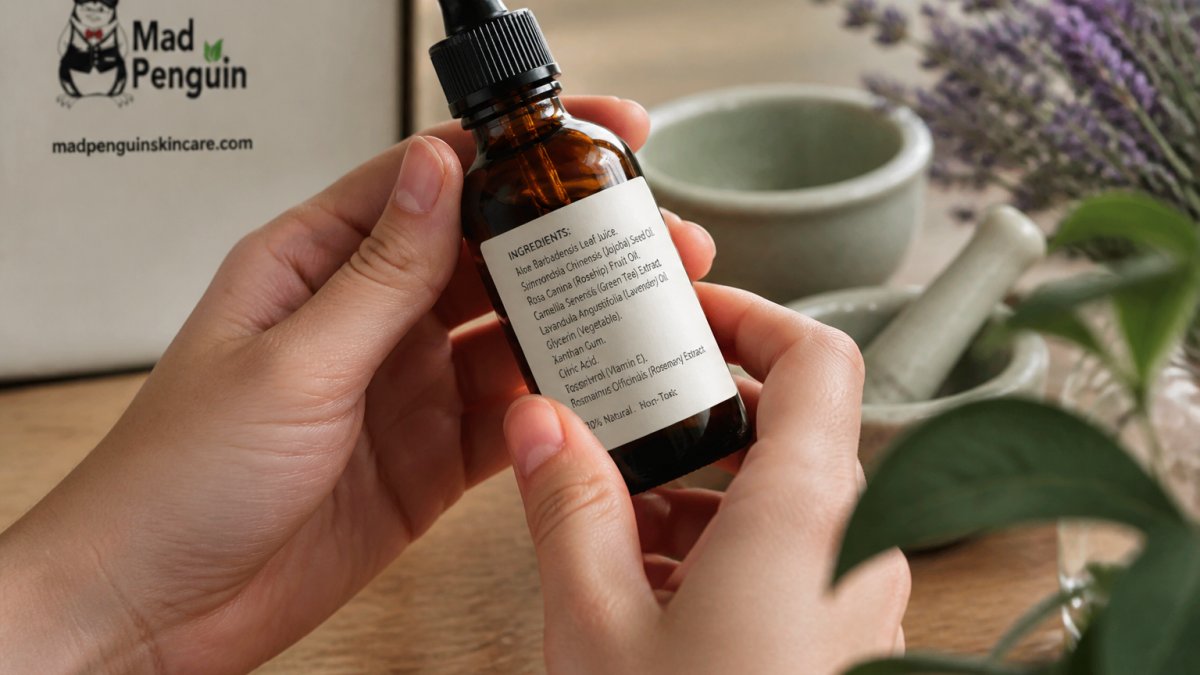
The price gap between drugstore and luxury natural skincare reflects real differences: concentration levels, active ingredient percentages, and stabilization systems that keep ingredients effective over months of use.
Mad Penguin Skincare is built on this principle: expensive natural skincare is only worth it when the price reflects real formulation quality, not just packaging aesthetics or brand prestige.
A high price tag doesn't guarantee results, but suspiciously low prices almost certainly mean corners were cut in ingredient concentration, sourcing, or stability.
The Role of Active Ingredients in Justifying Price
Active ingredients determine whether expensive natural skincare delivers.
Expensive formulations use higher active concentrations. A budget moisturizer might contain 2% hyaluronic acid; a premium formula 5-8%.
Why Natural Actives Cost More
Natural actives face stability challenges synthetic alternatives avoid.
Bakuchiol, a plant-derived retinol alternative, requires careful sourcing and extraction to preserve potency.
Niacinamide is more stable than vitamin C but still degrades with certain pH levels or light exposure.
The Clinical Evidence Gap
Many traditional botanicals lack decades of clinical data. Retinol has 40+ years of research; niacinamide has solid backing.
Price reflects research investment. Brands claiming bakuchiol reduces fine lines should cite published studies or third-party testing.
When evaluating expensive natural skincare, look for:
- Published studies (even small ones) in peer-reviewed journals or on the brand's website
- Third-party testing results showing active ingredient concentration matches label claims
- Stability data proving the active remains potent through the product's shelf life
- Mechanism explanations that go beyond marketing language (e.g., "Bakuchiol binds to retinoid receptors at a lower affinity than retinol, reducing irritation while maintaining efficacy")
Concentration Thresholds That Matter
Higher active concentrations require more sophisticated formulation work to remain stable and non-irritating, justifying higher prices.
True Botanicals vs. Marketing: How to Read Skincare Ingredient Labels
The FDA requires ingredients listed by concentration, highest to lowest.
Look for hero ingredients in the top five. If rose hip oil appears sixth, the concentration is too low. Marketing often emphasizes ingredients present in trace amounts.
Botanical names matter: "Rosa canina fruit oil" differs from "Rosa canina fruit extract." Oil contains more actives; extract is more stable but less potent. The choice reflects formulation priorities.
Avoid vague terms like "botanical complex" or "natural fragrance blend." Expensive natural skincare should list individual components clearly.
The most honest brands list full ingredients, explain each component, and publish third-party testing results.
Benefits of Non-Toxic Skincare for Long-Term Skin Health
Non-toxic skincare avoids synthetic fragrances, parabens, phthalates, and harsh actives that compromise your skin barrier over time through cumulative exposure.
Repeated exposure to synthetic preservatives and fragrance chemicals can trigger sensitivity, disrupt your skin barrier, and accelerate aging. Non-toxic formulations minimize this risk.
Non-toxic skincare supports your skin's natural repair: natural oils maintain barrier function, plant antioxidants protect against stress, gentle exfoliants preserve microbiome health. Over time, this produces genuinely healthier skin.
Sensitive skin sees immediate benefits; resilient skin ages better with fewer inflammatory compounds. Expensive natural skincare becomes worth it when you're paying for long-term skin health.
Cost-Per-Use Analysis: Making Expensive Natural Skincare Work for Your Budget
Focus on products you'll use daily. A daily moisturizer justifies higher investment because per-use cost stays low. A specialty serum used twice weekly doesn't.
Start with three essentials: a cleanser, moisturizer, and targeted treatment. The California Ocean Mineral Anti-Aging Moisturizer covers hydration and fine lines. The L.A. Hibiscus natural face scrub handles exfoliation. That's a functional routine.


Add one targeted product based on your specific need. The Goodbye Puffy Eyes Natural Antioxidant Eye Cream targets dark circles and fine lines. The Night's Best Friend Overnight Repair Cream intensifies hydration while you sleep.

| Product | Price | Use Frequency | Monthly Cost |
|---|---|---|---|
| Daily Moisturizer | $33 | Twice daily | $4.13 |
| Face Scrub | $27 | 2x weekly | $1.69 |
| Night Cream | $35 | Nightly | $4.38 |
| Eye Cream | $33 | Twice daily | $4.13 |
The key is consistency. An expensive product you use sporadically costs more per application than a budget product you use daily. Expensive natural skincare only justifies its cost when it becomes part of your actual routine.
Affordable vs. Luxury Formulations: Where the Real Difference Lies
Price doesn't correlate perfectly with efficacy. A $15 vitamin C serum and a $60 serum might contain similar concentrations.
The Diminishing Returns Curve in Natural Skincare
Efficacy doesn't increase linearly with price.
Budget products ($8-$15) offer basic formulations with subtherapeutic active concentrations and minimal stability systems. They work adequately for basic cleansing and hydration.
Mid-tier products ($20-$40) deliver therapeutic active concentrations with sophisticated formulation and effective stability systems. Mad Penguin's California Ocean Mineral Anti-Aging Moisturizer exemplifies this range, delivering measurable hydration and fine-line reduction.
Luxury products ($50-$150+) show diminishing returns. You're paying for sensory experience, brand prestige, and marginal improvements rather than additional efficacy.
Where Expensive Natural Skincare Still Justifies Cost
The diminishing returns curve has exceptions. Certain product categories and skin conditions justify higher spending:
Targeted treatments (serums, eye creams) justify higher prices through higher active concentrations. A $33 eye cream can contain specialized botanicals, producing visible results within 4-6 weeks.
Formulations for sensitive or compromised skin barriers benefit from expensive natural skincare's investment in purity and stability.
Supply chain transparency and ethical sourcing genuinely cost more.
Clinical testing and stability verification add cost.
Where Expensive Natural Skincare Wastes Money
Avoid overpaying for:
- Trendy botanicals without clinical evidence (adaptogens, rare plant extracts marketed as "superfoods for skin") that appear in luxury formulations but lack published efficacy data
- Luxury packaging that adds 15-25% to the product cost without improving skin outcomes
- Multi-step routines marketed as necessary when a three-product routine (cleanser, treatment, moisturizer) delivers 90% of the results
- Products claiming to replace professional treatments (lasers, injectables, professional peels) when no topical skincare can match those outcomes
Building Your Personal Efficacy Threshold
Your optimal price point depends on three factors:
-
Skin sensitivity: Sensitive skin justifies higher spending ($30-$50 per product) for formulation precision. Resilient skin can use budget products effectively.
-
Specific concerns: Basic hydration and cleansing plateau at $20-$35. Targeted concerns (aging, hyperpigmentation, acne) benefit from $35-$60 products with higher active concentrations.
-
Consistency: An expensive product you use sporadically costs more per application than a budget product you use daily. The most expensive skincare is the one gathering dust on your shelf.
For most people, the sweet spot is $25-$40 per product for daily-use items (cleanser, moisturizer) and $30-$50 for targeted treatments.
How to Build a Skincare Routine Without Overspending on Natural Products
A functional skincare routine requires three steps: cleanse, treat, moisturize. Everything else is optional. Start here before adding anything.
Cleansing removes dirt, oil, and environmental debris without stripping your skin barrier. A gentle cleanser works for all skin types. The L.A. Hibiscus natural face scrub doubles as both cleanser and exfoliant, eliminating the need for a separate product.
Treating means addressing your primary concern. Dryness? Use a hydrating serum before moisturizer. Dullness? Exfoliate twice weekly. Fine lines? Add a retinol alternative or vitamin C serum.
Moisturizing locks hydration into your skin. The California Ocean Mineral Anti-Aging Moisturizer works for all skin types because it hydrates without occlusion. Use it twice daily as your routine's foundation.
Only after establishing this three-step routine should you consider additions. A night cream intensifies hydration while you sleep.
Expensive natural skincare is worth it when the price reflects formulation quality, active ingredient concentration, and sourcing transparency.
The real question isn't whether expensive natural skincare is worth it, it's whether a specific product is worth it for your specific needs. Read labels. Calculate cost-per-use. Start with essentials.
Mad Penguin Skincare proves you don't have to choose between effective results and clean, non-toxic ingredients. Our formulations prioritize active ingredient concentration and supply chain transparency at accessible price points. Shop our complete skincare collection to find products that match your skin type and budget.
Frequently Asked Questions
Does expensive natural skincare really make a difference?
Yes, but not always in the way marketing suggests. Expensive natural skincare often contains higher concentrations of active ingredients, better preservation systems, and superior sourcing practices. However, results depend on matching the right formulation to your skin type and concerns. A $33 natural moisturizer like Mad Penguin's California Ocean Mineral Anti-Aging Moisturizer can deliver measurable hydration and reduce fine lines through consistent use, but only if the active ingredients target your specific needs. Price alone doesn't guarantee efficacy; ingredient quality and concentration levels do.
Is natural skincare actually safer than conventional alternatives?
Natural skincare can be safer for sensitive skin when formulated without synthetic fragrances, harsh chemical additives, and common allergens like contact dermatitis triggers. However, 'natural' doesn't automatically mean safe, some botanical extracts cause irritation in certain individuals. The real advantage comes from transparency: brands committed to non-toxic formulations typically disclose their full ingredient lists and avoid preservative systems that compromise skin barrier integrity. Mad Penguin Skincare focuses on clean formulas free from unnecessary harsh chemicals, which reduces the risk of irritation for people with reactive skin.
What ingredients justify a higher price point in expensive natural skincare?
Active ingredients that justify premium pricing include stabilized retinoids, high-concentration antioxidants (like vitamin C from real sources), peptides that support collagen production, and bioavailable forms of botanical extracts. Ocean minerals, when properly sourced and concentrated, also command higher costs due to supply chain transparency and clinical efficacy testing. Products like Night's Best Friend Overnight Repair Cream use botanical oils and vitamins in concentrations proven to improve skin texture and reduce fine lines, these formulations cost more because the ingredients themselves are expensive and the stability requirements are rigorous.
How can you tell if a natural skincare product is worth the investment?
Evaluate products using three criteria: ingredient concentration (active ingredients should appear near the top of the label), clinical testing or dermatologist-tested claims, and cost-per-use (a $35 night cream used for 6 months costs about $0.19 per application). Check for supply chain transparency, brands willing to disclose sourcing practices typically invest in quality. Look for products addressing your specific concern: if you have dryness and fine lines, the California Ocean Mineral Anti-Aging Moisturizer targets both through ocean minerals and hydration. Avoid products making vague 'clean beauty' claims without backing them with third-party certifications or detailed ingredient sourcing.