

Table of Contents
- Assess Your Current Skincare Habits
- Understanding the Benefits of Skinimalism
- Choose Products with Eco-Friendly Skincare Ingredients to Avoid
- Select Refillable and Minimal Packaging Options
- Build Your Core Sustainable Skincare Routine
- How to Recycle Beauty Product Packaging Responsibly
- Transition Gradually Without Compromising Results
- Frequently Asked Questions
Last Updated: September 30, 2026
Assess Your Current Skincare Habits
Building a sustainable skincare routine starts with understanding what you're already using. Take time to look at every product on your shelf: cleansers, moisturizers, serums, and treatments. Check the packaging materials. Read the ingredient lists. Ask yourself honest questions about which products actually work for your skin and which ones you keep out of habit.
Switching to sustainable skincare doesn't mean abandoning results, the goal is finding products that deliver real benefits while reducing environmental impact.
Write down what you're using now. Note:
- Product names and brands
- Packaging type (plastic, glass, metal, cardboard)
- How often you use each item
- Whether it actually works for your skin concerns
- Ingredients you want to avoid
This simple inventory becomes your roadmap. It helps you identify which products to replace first and which ones are already aligned with your values.
Understanding the Benefits of Skinimalism
Skinimalism is the practice of using fewer, simpler products in your routine while still addressing your skin's core needs. It's not about using nothing, it's about using only what works.
Fewer products mean fewer ingredients touching your skin, reducing irritation risk. Simpler routines are easier to stick with, save money, and take less time.
More products don't equal better results, layering too many actives overwhelms your skin. A simplified routine with the right products often outperforms a complicated one.
Every product you don't buy means less packaging waste, less manufacturing water, and fewer emissions. Reducing to essentials cuts your carbon footprint without sacrificing skin health.
Consider starting with a three-step sustainable skincare routine:
- A gentle cleanser
- A hydrating moisturizer
- Sun protection (if daytime)
Add targeted treatments only if your skin needs them. This approach prevents product buildup, reduces overwhelm, and aligns with both skinimalism principles and environmental responsibility.
Choose Products with Eco-Friendly Skincare Ingredients to Avoid
Not all "natural" ingredients are sustainable. Some require intensive farming that harms ecosystems or come from endangered species. Some synthetic ingredients are actually more sustainable than their natural counterparts.
The Natural vs. Sustainable Paradox
Growing rose petals for rose water requires significant irrigation in water-scarce regions, while synthetic glycerin may use less water overall. Natural argan oil is sustainable only when fair-trade certified; mass-market argan farming has driven deforestation.
The key is understanding where an ingredient comes from and how it's produced, not just whether it's labeled natural.
Ingredients to reconsider:
- Palm oil and palm kernel oil. Often linked to rainforest destruction and habitat loss for endangered species. Look for sustainable alternatives or products that skip it entirely. When you do see palm oil, verify it carries RSPO (Roundtable on Sustainable Palm Oil) certification.
- Mica. Mining harms workers and ecosystems. Synthetic alternatives like iron oxides are more traceable.
- Talc. Mining disrupts ecosystems and causes contamination. Choose alternatives instead.
- Synthetic fragrances. Derived from petrochemicals and VOCs that pollute air. Natural fragrance oils are better if not from endangered plants.
- Microplastics. Tiny plastic beads used in some exfoliants. Choose physical exfoliants like natural scrubs or biodegradable alternatives instead.
- Unsustainably harvested botanicals. Sandalwood, rosewood, and orchid extracts come from threatened species. Check certifications before buying.
Ingredients worth seeking out:
- Plant extracts with proven benefits and sustainable sourcing (green tea from certified farms, hibiscus, seaweed from managed harvests).
- Oils that support sustainable farming practices (jojoba requires minimal water; argan when fair-trade certified; sunflower from regenerative farms).
- Mineral-based UV filters (zinc oxide, titanium dioxide) instead of chemical filters like oxybenzone, which harm coral reefs and aquatic ecosystems.
- Preservatives that extend shelf life without harsh synthetics, look for phenoxyethanol or sodium benzoate from reputable sources, or natural preservatives like rosemary extract when formulated correctly.
- Upcycled or byproduct ingredients (grape seed oil from winemaking, coffee extract from spent grounds) that reduce waste.
How to verify ingredient sourcing:
Check for third-party certifications: ECOCERT or COSMOS (organic sourcing), Fair Trade Certified (fair wages), Leaping Bunny (no animal testing), and Rainforest Alliance (responsible farming).
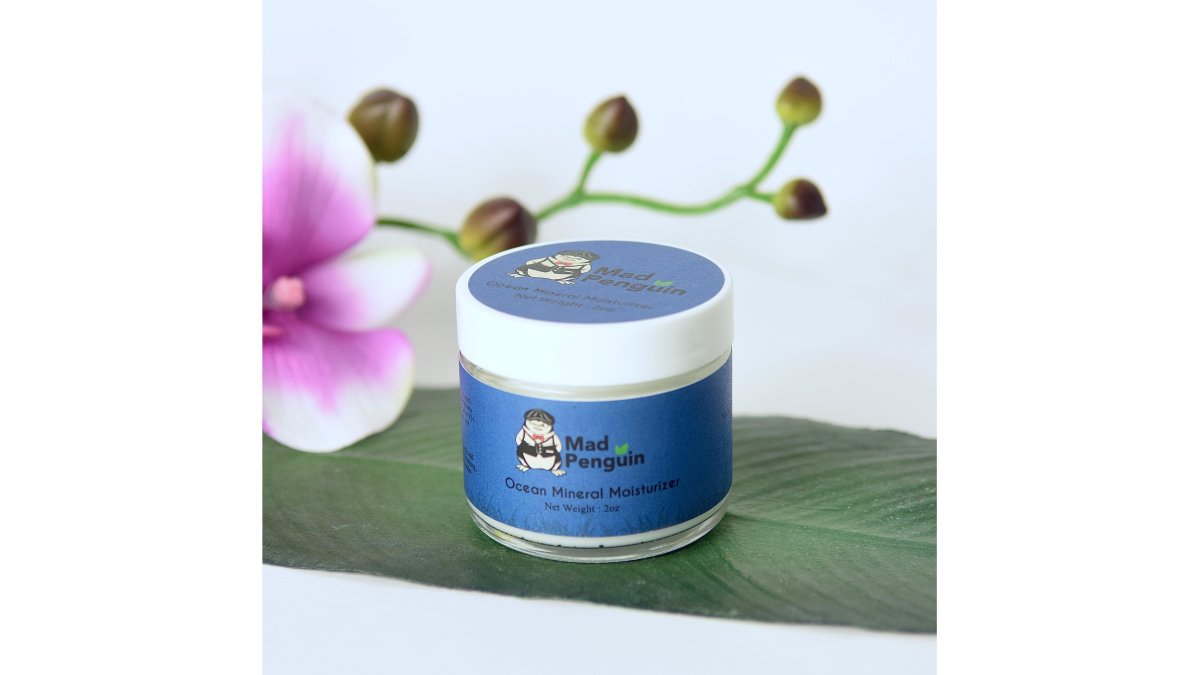
Mad Penguin Skincare products avoid problematic ingredients while prioritizing efficacy and sustainability. The L.A. Hibiscus natural face scrub uses hibiscus, rich in vitamin C and antioxidants, instead of microplastics. The California Ocean Mineral Anti-Aging Moisturizer uses ocean minerals.

Select Refillable and Minimal Packaging Options
Packaging waste is a major environmental impact of conventional skincare. Choosing refillable and minimal packaging is one of the fastest ways to reduce your footprint.
With refillable packaging, you buy a product in a refillable container, then purchase refills in smaller packages that use less material and cost less to ship, saving money and cutting waste.
Look for these packaging options:
- Glass jars and bottles (recyclable and reusable)
- Aluminum containers (infinitely recyclable)
- Cardboard and paper (compostable)
- Refill stations (some brands offer mail-back programs)
- Solid formulations (bars and balms require minimal packaging)
Minimal packaging means stripping away unnecessary materials. Some brands use plastic-free cardboard boxes. Others skip outer packaging entirely. The goal is protection without excess.
When building a sustainable skincare routine, packaging should influence your choices as much as the formula. A product in recyclable glass that you'll use completely beats one in plastic you'll discard half-full.
Build Your Core Sustainable Skincare Routine
Your sustainable skincare routine should address your skin's specific needs without excess. Start here and add only what's necessary.
Step 1: Cleanse Use a gentle cleanser that removes dirt and oil without stripping. The L.A. Hibiscus natural face scrub cleanses and gently exfoliates while leaving skin soft and hydrated.

Step 2: Hydrate and Moisturize The California Ocean Mineral Anti-Aging Moisturizer delivers deep hydration with ocean minerals that support skin firmness and reduce fine lines.
Step 3: Protect If you're going outside, use sun protection. This is the most important step for preventing premature aging and skin damage.
Step 4: Target Specific Concerns (Optional) Add one targeted treatment if needed. The Goodbye Puffy Eyes natural antioxidant eye cream addresses under-eye concerns, or Night's Best Friend overnight repair cream supports skin restoration.
The Healthy Skin Routine bundle from Mad Penguin Skincare includes cleanser, moisturizer, eye cream, and night cream.

How to Recycle Beauty Product Packaging Responsibly
Recycling skincare packaging correctly matters, contaminated containers or improper sorting send recyclables to landfills instead of processing facilities.
Before you recycle:
- Empty the container completely
- Rinse it with a small amount of water
- Remove pumps, caps, and applicators (these often jam sorting equipment)
- Check local recycling guidelines, rules vary by location
Packaging types and how to handle them:
- Glass jars: Rinse and recycle with regular glass
- Plastic bottles: Check the number (1, 2, or 5 are most recyclable)
- Aluminum tubes: Rinse and recycle with metal
- Cardboard boxes: Flatten and recycle with paper
Transition Gradually Without Compromising Results
Switching your entire routine overnight can shock your skin. A gradual transition gives your skin time to adjust and lets you track costs to discover where you save money.
The Cost-Benefit Reality of Sustainable Skincare
- Refillable products reduce per-use cost by 30-50% since you skip packaging.
- Concentrated formulas mean you use less per application, so bottles last longer.
- Skinimalism reduces total spending, a three-step routine costs less than a ten-step one.
- Multi-functional products eliminate redundancy (like the L.A. Hibiscus natural face scrub that cleanses and exfoliates).
- Better formulations reduce waste since products that work mean no half-empty bottles.
Track your spending during transition:
Gradual transition timeline:
Watch for adjustment periods:
- New cleansers may feel different initially (often lighter, less stripping).
- Moisturizers have varying textures; give your skin 2-3 weeks to adjust.
- Some ingredients take 4-6 weeks to show benefits (vitamin C, niacinamide, peptides).
- Exfoliating products may cause mild purging in the first 1-2 weeks; this is normal.
Frequently Asked Questions
What is the most important first step when building a sustainable skincare routine?
Start by assessing what you currently use and why. Identify products that actually work for your skin versus those you use out of habit. Many people maintain routines with 8-10 products when 3-4 well-chosen ones deliver better results. This audit reveals which products you genuinely need, reducing waste and unnecessary spending. Once you know your essentials, you can replace them with sustainable alternatives that match your skin type and concerns.
How does skinimalism improve both skin health and environmental impact?
Skinimalism, using fewer, more intentional products, reduces the number of synthetic chemicals touching your skin while cutting packaging waste and carbon emissions from shipping. Fewer products means less irritation, better ingredient absorption, and easier identification of what works for your skin. The environmental benefits of skinimalism include lower water usage in manufacturing, reduced plastic waste, and decreased transportation emissions. Mad Penguin Skincare's approach aligns with this philosophy by offering multi-functional formulas that address multiple concerns in one product.
What eco-friendly skincare ingredients should I avoid, and why?
Avoid microplastics (often labeled as polyethylene or polypropylene), synthetic fragrances that bioaccumulate in water systems, and palm oil from non-sustainable sources. Instead, look for certified natural alternatives like plant-based exfoliants, essential oils, and sustainably sourced botanicals. Check ingredient lists carefully, greenwashing is common, so verify third-party certifications or transparent sourcing claims.
How long does it take to see results when transitioning to a sustainable skincare routine?
Most people notice visible changes within 4-6 weeks of consistent use, though skin texture improvements can appear in 2-3 weeks. The timeline depends on your skin type, the specific concerns you're addressing, and the products you choose. Quality natural ingredients like those in Mad Penguin Skincare's formulas work effectively, but they may work differently than harsh chemical alternatives. Allow at least one full cycle (6-8 weeks) before deciding if a sustainable routine works for you, as this gives your skin time to adjust and show real improvement.