

Table of Contents
- What Combination Skin Actually Is (and Why It Happens)
- A Natural Routine That Helps Fix Combination Skin
- The Best Natural Ingredients for Combination Skin
- How Long Does It Take to Balance Skin Naturally?
- Common Mistakes When Treating Combination Skin
- How to Fix Combination Skin Naturally Through Diet and Lifestyle
- Frequently Asked Questions
Last Updated: September 14, 2026
What Combination Skin Actually Is (and Why It Happens)
Combination skin is a skin type where the T-zone (forehead, nose, and chin) produces more oil while the cheeks stay dry or normal, because oil glands in the T-zone are more active, a pattern largely shaped by genetics and hormones.
If you're trying to figure out how to fix combination skin naturally, the first step is understanding that "fixing" doesn't mean forcing your skin into one uniform type, it means balancing two different needs at once. Most routines fail because they treat your face as a single zone.
Signs You Have Combination Skin
- Oily shine on your forehead, nose, and chin by midday
- Cheeks that feel tight, flaky, or rough after washing
- Visible pores in the T-zone but not on the cheeks
- Blackheads or congestion in the center of your face
- Products that work on one area cause problems on another
If three or more of these sound familiar, you're dealing with combination skin, not just "confused" skin.
A Natural Routine That Helps Fix Combination Skin
A natural routine for combination skin works by cleansing gently, hydrating strategically, and treating each zone according to its needs. Three steps done consistently beat a ten-product shelf, and the difference usually comes down to pH, timing, and whether you'll make a few things yourself.
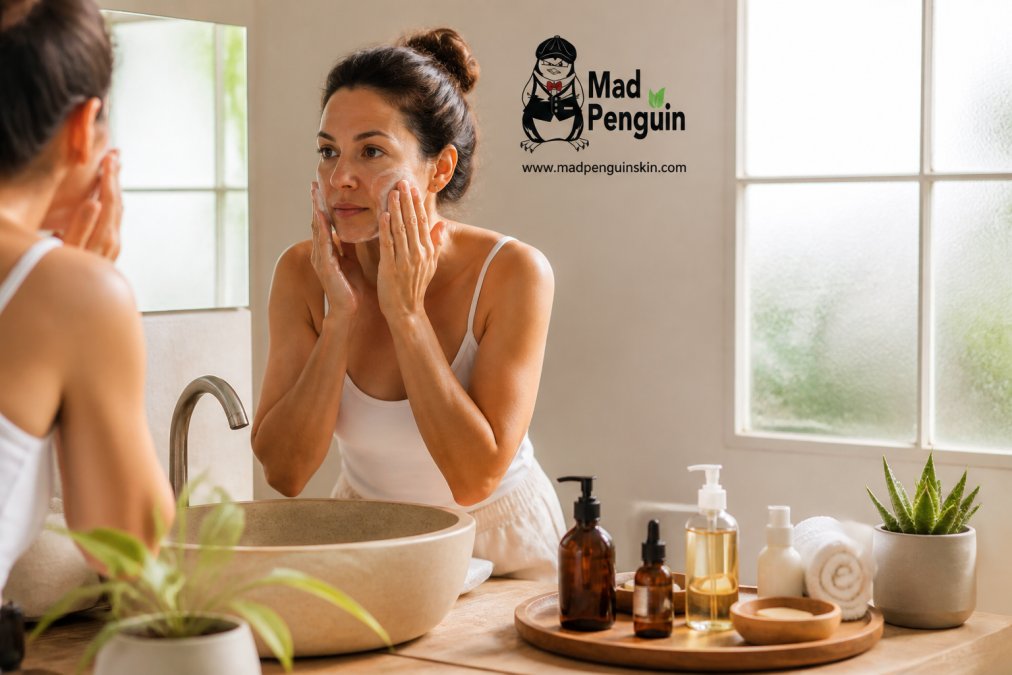
Step 1: Cleanse Without Stripping
Use a gentle, sulfate-free cleanser with a slightly acidic pH, ideally 4.5 to 5.5, matching your skin's acid mantle (pubmed.ncbi.nlm.nih.gov). Harsh foaming washes strip the lipid barrier, triggering your T-zone to produce more oil. Massage for 30 seconds with lukewarm water, then rinse. If you wear makeup or sunscreen, double cleanse at night.
DIY option: A raw honey cleanse works surprisingly well for combination skin. Honey is naturally acidic, draws water into the skin, and has mild antibacterial properties. Massage a teaspoon onto damp skin, leave two minutes, and rinse with lukewarm water. It won't remove heavy makeup, so save it for mornings or no-makeup days, honey is gentler on cheeks than any foaming wash while still keeping the T-zone calm.
Step 2: Tone and Hydrate
Skip alcohol-based toners. Reach for a hydrating toner with hyaluronic acid or botanical extracts to restore pH balance and prep skin for moisture without triggering oil production.
DIY option: Brew a strong cup of green tea, cool it completely, and pour it into a spray bottle. Green tea's EGCG calms redness and provides antioxidant support. Refrigerate up to three days. Mist after cleansing, then moisturize while skin is still damp. For more hydration, add a teaspoon of vegetable glycerin, a humectant that pulls water into the upper layers of your skin.
Step 3: Moisturize Differently by Zone
This is the step most people skip. Apply a lightweight, oil-free moisturizer to your T-zone and a richer cream to your cheeks. Our California Ocean Mineral Anti-Aging Moisturizer works well on dry areas, while a lighter layer on the center of your face keeps pores clear.

DIY option: For cheeks, a thin layer of pure aloe vera gel (no added alcohol or fragrance) seals in water without heaviness. For the T-zone, a few drops of jojoba oil mimic your skin's own sebum and can signal oil glands to slow down. Jojoba is a liquid wax ester, not a true oil, so it absorbs quickly and rarely clogs pores. Patch-test first if you're acne-prone.
Step 4: Exfoliate Selectively
Exfoliation is where combination skin gets tricky: over-exfoliating strips the cheeks and irritates the T-zone, while under-exfoliating leaves dead cells clogging pores in the center of your face. Aim for two to three times per week, using different methods on different zones.
DIY option: Mix a teaspoon of finely ground oatmeal with a tablespoon of plain yogurt. Oatmeal's avenanthramides soothe irritation, while yogurt's lactic acid provides gentle chemical exfoliation. Apply to the T-zone first, leave five minutes, then spread the remainder over your cheeks and rinse after two more minutes, a mild, dual-action exfoliant that won't leave either zone raw.
Step 5: Protect With Sunscreen
UV damage worsens both oiliness and dryness and is the biggest driver of premature aging. Choose a broad-spectrum sunscreen with SPF 30 or higher (the FDA). Mineral formulas built on zinc oxide or titanium dioxide tend to sit better on combination skin than heavy chemical sunscreens, though modern chemical filters work well too. Reapply every two hours outdoors.
DIY reality check: There is no reliable DIY sunscreen. Zinc oxide can be mixed into a lotion, but getting the SPF rating right at home is nearly impossible, and an inaccurate mix gives false protection. Buy this one.
A Sample Week
-
Monday, Wednesday, Friday: Gentle cleanse, green tea toner, zone-specific moisturizer, sunscreen.
-
Every night: Double cleanse if you wore sunscreen or makeup.
That's it. Five steps, two DIY recipes, and a schedule you can actually keep. If you'd rather not mix things yourself, our Hydrating Skin Starter Kit covers the cleanse-tone-moisturize basics in one bundle.

The Best Natural Ingredients for Combination Skin
The best natural ingredients for combination skin balance oil control with hydration: hibiscus, rosehip, aloe, green tea, and hyaluronic acid. Each addresses one side of the equation without disrupting the other. What separates a useful ingredient from a marketing claim is a clear mechanism and a concentration that actually does something.
Ingredients That Pull Their Weight
Hibiscus is rich in vitamin C and antioxidants that brighten dull skin and gently exfoliate, thanks to naturally occurring alpha-hydroxy acids that loosen dead cells. Our L.A. Hibiscus natural face scrub uses it to lift dead cells without the sting of harsh scrubs. Use it two to three times weekly; more risks over-exfoliating the cheeks.

Salicylic acid, found naturally in willow bark, is oil-soluble, so it travels into the pore lining where sebum collects, working on T-zone congestion in a way water-soluble acids can't. A willow bark infusion (steep a tablespoon of dried bark in hot water 15 minutes, strain, cool) makes a mild toner for oily zones, gentler than a drugstore serum but slower to show results.
Aloe vera calms inflammation and reduces redness on dry cheeks. The gel is roughly 99% water, so it hydrates without adding oil. Choose cold-pressed or whole-leaf aloe over reconstituted powders, which often lose the soothing polysaccharides.
Green tea is loaded with EGCG, an antioxidant that helps calm the inflammation that drives both redness and excess oil. Drink it, and use the cooled tea as a toner. Two-for-one.
Hyaluronic acid holds up to 1,000 times its weight in water, making it a powerful humectant. The catch: in dry climates it can pull moisture from your skin instead of the air. Apply to damp skin and seal with moisturizer.
Rosehip seed oil is high in linoleic acid, which sebum in acne-prone skin tends to lack, one reason it's well tolerated on oily and combination skin despite being an oil. A few drops pressed into the cheeks at night is enough.
| Ingredient | Best For | How to Use | Watch Out For |
|---|---|---|---|
| Hibiscus | Dullness, texture | 2-3x weekly exfoliation | Over-exfoliation on cheeks |
| Salicylic acid (willow bark) | T-zone congestion | Spot-treat oily areas | Drying if used daily |
| Aloe vera | Cheek dryness, redness | Layer under moisturizer | Added alcohol in cheap gels |
| Green tea | Inflammation, antioxidants | Toner or serum | Fades within 3 days |
| Hyaluronic acid | Overall hydration | Apply to damp skin | Can dry skin in low humidity |
| Rosehip seed oil | Barrier support, cheeks | 2-3 drops at night | Goes rancid if stored warm |
Ingredients to Avoid
- Denatured alcohol in toners and mists, it strips the barrier and triggers rebound oil.
- Sodium lauryl sulfate (SLS), a harsh surfactant that leaves cheeks tight.
- Heavy occlusives like petrolatum on the T-zone, fine on cheeks, pore-clogging in the center of the face.
- Fragrance and essential oils at high concentrations, common irritants, especially on already-dry cheeks.
- Physical scrubs with jagged particles (walnut shell, apricot kernel), they create microtears that worsen both oiliness and sensitivity.
How to Read a Label
Ingredients are listed by concentration, highest to lowest. If an active like hibiscus or green tea appears after the preservative (often phenoxyethanol or sodium benzoate), there isn't enough to do much, look for it in the top third.
If you'd rather skip the label-reading, our Night's Best Friend Overnight Repair Cream is formulated with barrier-supporting ingredients and no added fragrance, and you can browse the full range at madpenguinskincare.com.
How Long Does It Take to Balance Skin Naturally?
Balancing skin naturally typically takes four to eight weeks of consistent routine. Your skin's outer layer renews roughly every 28 days, so you need at least one full cycle, often two, before you see real change (pubmed.ncbi.nlm.nih.gov).
The first two weeks often feel worse before better: switching from harsh products can trigger purging or temporary dryness as the barrier repairs. Push through. By week four, most people notice less midday shine and softer cheeks; by week eight, balance becomes your new normal.
Natural approaches take longer than prescription options, but they're gentler on sensitive skin and avoid the rebound irritation that comes with stripping ingredients. Consistency matters more than intensity here.
Common Mistakes When Treating Combination Skin
The most common mistakes when treating combination skin are over-cleansing, using one product for the whole face, skipping moisturizer on oily zones, and over-exfoliating. Each one sabotages the balance you're trying to build.
- Over-cleansing: Washing more than twice daily strips the barrier and triggers rebound oil.
- One-size-fits-all products: Your cheeks and T-zone have different needs. Treat them differently.
- Skipping moisturizer on oily areas: Dehydrated skin overproduces sebum. Even oily zones need lightweight hydration.
- Exfoliating too often: More than three times weekly damages the lipid barrier and causes flaky skin.
- Ignoring sunscreen: UV damage worsens both oiliness and dryness. Use a non-comedogenic, dermatologist-tested sunscreen daily.
How to Fix Combination Skin Naturally Through Diet and Lifestyle
Diet and lifestyle influence combination skin from the inside: hydration, omega-3s, and stable blood sugar support the skin barrier, while hormonal fluctuations and stress drive oil production, an angle most skincare guides skip.
Drink enough water. Eat fatty fish, walnuts, and flaxseed for omega-3s that support the lipid barrier. Cut back on high-glycemic foods, which spike insulin and can increase sebum production. A small change in diet often shows up on your face within a month.
Hormonal cycle impact is real: many women notice oilier skin and breakouts the week before their period as progesterone and testosterone shift. Track your cycle alongside your skin so you can adjust your routine during those days rather than fighting it blindly.
Internal versus external balance matters too: no topical product fixes poor sleep, chronic stress, or dehydration. Treat your routine as one part of a larger system. A Hydrating Skin Starter Kit covers the external side in one bundle, but the internal work is on you.
Fixing combination skin naturally comes down to patience and precision: gentle cleansing, zone-specific moisture, and consistency over at least two skin cycles. If you're tired of guessing which product goes where, Mad Penguin Skincare builds clean, non-toxic formulas designed for exactly this kind of split. Our Night's Best Friend Overnight Repair Cream supports barrier repair while you sleep, and our full range is made with natural, responsibly sourced ingredients in eco-friendly packaging. Visit madpenguinskincare.com to build a routine that works for both sides of your face.
Frequently Asked Questions
What ingredients are not good for combination skin?
Heavy occlusives like coconut oil and thick petrolatum-based creams can clog the oily T-zone and trigger breakouts. Alcohol-based toners strip the cheeks and make dryness worse. Fragrance and harsh sulfates can irritate both zones. Stick with non-comedogenic, water-based formulas and gentle cleansers that respect your skin barrier rather than fight it.
What are the main causes of combination skin?
Genetics play the biggest role, but hormones, stress, and environment matter too. Sebum production is higher in the T-zone because those glands are more active. External factors like dry indoor air, hot showers, and over-cleansing can make the dry areas drier while the oily areas stay oily. That is why a single-zone approach rarely works.
Can natural oils help balance combination skin?
Yes, if you choose the right ones. Light, non-comedogenic oils like jojoba, rosehip, and squalane mimic skin's natural sebum and can signal your skin to produce less oil. Apply them only to dry areas or mix a drop into your moisturizer. Heavy oils like coconut or wheat germ belong nowhere near an oily T-zone.
Is combination skin type rare?
No. Combination skin is one of the most common skin types. Most adults have some version of it, with an oilier T-zone and drier cheeks. It often shifts with seasons, hormones, and age. Recognizing it is the first step toward building a routine that actually fits your skin instead of fighting it.