

Last Updated: October 30, 2026
Quick Summary
To store natural skincare, keep it in a cool, dry, dark spot with stable temperatures between 15-25°C, such as a bedroom drawer or closed cabinet. Avoid hot, steamy, or sunlit places like bathroom counters, and keep containers tightly closed with clean hands and tools to prevent contamination.
- Bathrooms are often the worst storage room because hot showers raise humidity and speed spoilage.
- Refrigerate only water-based serums, eye creams, and products you will finish within their period-after-opening window.
- Write the open date on the label the day you break the seal and set a phone reminder for the PAO date.
- A 6M period-after-opening label means the product stays fresh for six months after first opening.
- Stop using any product with a changed smell, separated texture, discoloration, mold, or a stinging feel.
Table of Contents
- Why Storing Natural Skincare Correctly Matters
- The Best Place to Store Skincare Products
- Does Skincare Need to Be Refrigerated?
- How to Prevent Skincare Contamination
- Understanding Natural Skincare Shelf Life
- Storage Tips by Product Type: Creams, Serums, and Powders
- How to Tell If Your Natural Skincare Has Spoiled
- Shop Mad Penguin Skincare for Fresh, Effective Formulas
- Frequently Asked Questions
Why Storing Natural Skincare Correctly Matters
How you store natural skincare to keep it fresh decides whether your products work as intended or fade before you finish the jar. Natural formulas often skip the heavy synthetic preservative load found in conventional cosmetics, so they depend more on smart storage habits. Heat, light, and air all speed up ingredient degradation. Get storage right and you protect both freshness and effectiveness.
We at Mad Penguin Skincare build our clean formulas around natural, non-toxic ingredients. That makes storage advice part of the product, not an afterthought. Below, we'll show you exactly how to store natural skincare so every jar and bottle stays effective from first use to last.
The Best Place to Store Skincare Products
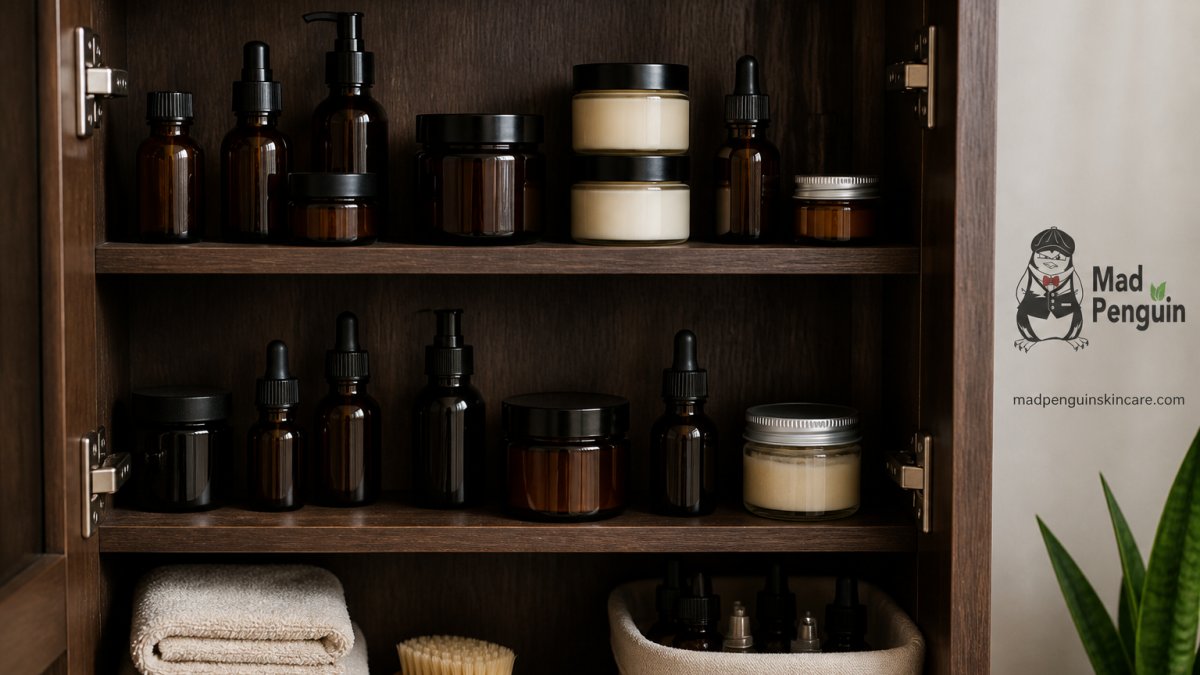
The best place to store skincare products is a cool, dry, dark spot where temperatures stay stable. A bedroom drawer, a closed cabinet, or a shelf away from windows all work well. Avoid anywhere hot, steamy, or sunlit.
Your storage spot should check three boxes:
- Cool enough to avoid heat spikes
- Dry enough to limit moisture
- Dark enough to block direct sunlight
Ideal Temperature and Light Conditions
A 15-25°C storage range is recommended to help prevent ingredient degradation, according to Zenchemy Lab's guide to storing natural skincare. In practice, that means normal room temperature works for most products. Keep jars out of direct sunlight, since UV exposure can break down natural ingredients over time. A closed drawer or cabinet solves both problems at once.
Bathroom vs. Bedroom Storage
Bathrooms feel convenient, but they're often the worst room in the house for skincare. Hot showers push humidity up fast, and moisture speeds up spoilage. If you must store products in the bathroom, keep them inside a closed cabinet, not on the counter. Bedrooms win here: cooler, drier, and easy to keep dark.
Does Skincare Need to Be Refrigerated?
Skincare generally does not need refrigeration for ordinary storage. For a specific moisturizer formula that benefits from cool storage, see our California Ocean Mineral Anti-Aging Moisturizer. Most natural products stay fresh in a cool, dark drawer at room temperature. Refrigeration may suit a few specific formulas, and a fridge will not rescue a poorly preserved homemade product.

What Belongs in the Fridge (and What Doesn't)
Some products do well in the fridge:
- Water-based serums with delicate plant extracts
- Eye creams for a cooling, de-puffing feel
- Anything that feels soothing chilled in summer
Leave these out:
- Oil-based products, which can thicken and cloud
- Powders, which pick up moisture
- Anything in a large jar you use daily, since constant temperature swings do more harm than good
How to Refrigerate Without Ruining the Formula
A fridge is not a magic freshness switch. Cold storage introduces its own risks, and most of them come from how you move products in and out of the fridge rather than from the cold itself.
- Condensation is the enemy. Every time you pull a cold jar into a warm bathroom, water vapor condenses on the surface and lid threads. That moisture can migrate into the formula and feed microbial growth. Let the product come to room temperature before opening, or store it in a sealed secondary container.
- Emulsions can separate. Creams and lotions are oil-and-water emulsions held together by emulsifiers. Repeated freeze-thaw cycles or near-freezing spots in the fridge can cause separation or graininess that no amount of stirring fixes. Keep refrigerated products away from the back wall and the crisper drawer, where temperatures dip lowest.
- Oils can solidify. Coconut oil, shea butter, and other saturated fats turn solid below roughly 76°F. That is harmless, but it changes texture and makes dosing unpredictable. If a balm or body butter firms up, warm it in your hands rather than reheating the whole jar.
- Preservation still matters. Cold slows microbial growth but does not stop it. A preservative-free DIY formula in the fridge is still a short-term product, not a long-term one.
A practical rule: refrigerate only the products you will finish within their period-after-opening window, and keep them in a dedicated sealed bin so they are not exposed to food odors or spills.
How to Prevent Skincare Contamination
Contamination is the quiet reason many natural products spoil early. Every time you dip fingers into a jar, you introduce bacteria. Clean habits slow bacterial growth and protect the preservatives that keep a formula stable.
The fix is simple and consistent:
- Wash hands before every use
- Use a small spatula for jar products
- Keep containers tightly closed after use
- Never add water to a product to stretch it
Clean Hands, Tools, and Containers
Store tools like spatulas in a clean, dry spot, and wash them weekly. When you finish a product, recycle the packaging properly rather than reusing it for a DIY mix. Our step-by-step recycling guide shows how to handle each packaging type.
Understanding Natural Skincare Shelf Life
Natural skincare shelf life varies by formula, but most products stay fresh for a set window after opening. Shelf life is the period a product remains effective and safe to use. Unopened products often last longer than opened ones.
Check two things on every product:
- The expiry date, which marks the end of the unopened shelf life
- The period-after-opening label, often a small jar symbol with a number like 6M or 12M
Once opened, follow that opened-product window even if the expiry date is far off. To minimize waste while you track freshness, learn how to build a sustainable skincare routine.
How to Read Expiry Dates and Period-After-Opening Labels
The open-jar symbol (sometimes called the PAO symbol) is a small drawing of a jar with its lid flipped open, stamped with a number and the letter M. The M stands for months. A 6M label means the product is intended to stay fresh for six months after you first open it; 12M means twelve months. The clock starts the day you break the seal, not the day you buy it.
A printed expiry date works differently. It applies to the sealed, unopened product. If a jar says "EXP 03/2027" and carries a 6M PAO symbol, the product is good until March 2027 while sealed, but only six months after you open it, whichever comes first. If you open it in February 2027, you have until August 2027 by the PAO clock, but the printed date no longer protects you past March. The earlier of the two dates wins.
Why Opening Shortens Shelf Life
Every time you open a jar, three things happen at once. Oxygen enters and begins oxidizing oils and delicate plant actives. Airborne microbes land on the surface. And if you dip fingers or a damp tool, you add water and skin flora directly into the formula. Repeated open-close cycles compound all three.
That is why a wide-mouth jar used twice a day can spoil well before its PAO window, while a pump bottle of the same formula lasts longer. Packaging is part of the preservation system. A pump or airless bottle limits air and finger contact; a jar does not. If a natural cream comes in a jar, treat the PAO as a ceiling, not a guarantee.
A Simple Freshness-Tracking Habit
- Write the open date on the label with a permanent marker the day you break the seal.
- Set a phone reminder for the PAO date so you are not guessing months later.
- Store the newest products at the back of your drawer and the oldest at the front, so you use them in order.
- Finish one product before opening its backup when you can, since an unopened backup keeps its full shelf life only while sealed.
If a product passes its PAO date but still looks, smells, and feels normal, use judgment: appearance alone cannot confirm safety, and the conservative choice is to replace it. Our Healthy Skin Routine includes a moisturizer, scrub, eye cream, and night cream as a complete set.

Storage Tips by Product Type: Creams, Serums, and Powders
Different formulas need slightly different handling. A cream in a wide jar faces more air exposure than a serum in a pump bottle. Match your storage to the product type and you'll keep more of each formula fresh.
| Product Type | Best Storage Spot | Key Risk | Quick Tip |
|---|---|---|---|
| Creams | Cool, dark drawer | Finger contamination | Use a spatula, close tightly |
| Serums | Dark cabinet, some chilled | Light and heat | Keep in amber or opaque bottles |
| Powders | Dry cabinet | Moisture clumping | Keep away from the sink |
| Oils | Cool, dark shelf | Heat and light | Wipe the bottle neck clean |
Our Hydrating Skin Starter Kit includes our Hibiscus Scrub and our California Ocean Mineral Anti-Aging Moisturizer.

How to Tell If Your Natural Skincare Has Spoiled
Spoiled skincare usually announces itself before you use it. Watch for these signs:
- A changed smell, often sour or rancid
- Separated or curdled texture
- Discoloration from the original shade
- Mold or fuzz on the surface
- A stinging or burning feel on application
If a product shows any of these, stop using it. Freshness matters more than finishing the jar. Some natural ingredients degrade faster than others, so knowing which ones to watch helps. Our guide to natural skincare ingredients to avoid covers which ones can accelerate degradation.
Shop Mad Penguin Skincare for Fresh, Effective Formulas
Keeping natural skincare fresh is mostly about small habits: cool storage, clean hands, closed lids, and honest label checks. Do those consistently and your products reward you with better results for longer.
At Mad Penguin Skincare, we build our clean formulas on natural, non-toxic ingredients and offer eco-friendly, responsibly made skincare. Our Healthy Skin Routine bundles a moisturizer, scrub, eye cream, and night cream so your whole routine lives in one well-organized spot. Every product is made for all skin types and free from harsh additives.
Ready to build a routine worth storing well? Get started with Mad Penguin Skincare and give your skin clean, effective care that stays fresh from first use to last.
Frequently Asked Questions
Should I keep my natural skincare products in the bathroom?
A bathroom can work if it stays cool and dry, but steam from showers raises heat and humidity, which can speed up ingredient degradation. If your bathroom gets steamy, store products in a closed cabinet or move them to a bedroom shelf or drawer. Always close containers tightly after use and keep them away from direct sunlight to help preserve freshness.
How can I tell if my natural skincare has gone bad?
Watch for changes in smell, texture, or color. Separation, a sour or rancid odor, or a suddenly gritty feel are signs a product may have spoiled. Also check the expiry date and period-after-opening label. If you notice irritation or breakouts after using a product that looks or smells different, stop using it. When in doubt, replace it.
Do natural skincare products need preservatives?
Preservatives help prevent bacteria and mold growth, especially in water-based formulas. Natural skincare can use preservative systems, but the limits of DIY preservation are real: a refrigerated homemade product might be safe for only a week or two. Mad Penguin Skincare offers clean formulas built on natural, non-toxic ingredients.
How long does natural skincare last after opening?
Shelf life after opening varies by formula and packaging. Check the period-after-opening symbol on the label, which shows how many months the product stays fresh once opened. Store them in a cool, dry place, close tightly, and use clean tools to extend usability.
