

Last Updated: November 1, 2026
Quick Summary
You can reduce skincare waste while traveling by packing only four core products, refilling reusable containers instead of buying single-use minis, switching to solid formats, planning quantities by trip length, and bringing leftovers home. These five choices cut packaging and half-used formula before they become trash.
- Pack one cleanser, one serum or eye cream, one moisturizer, and sunscreen, then apply the one in, one out rule.
- Wash reusable containers with warm soapy water and air-dry at least four hours before refilling.
- Fill containers to about 80 percent, or 70 percent for thin formulas, to prevent leaks from cabin pressure.
- Pack for the days you'll be gone plus one, using roughly 15 ml cleanser for a weekend and 30 ml for a week.
- Bring decanted leftovers home, use them up, or donate sealed unopened items after calling ahead to check.
Table of Contents
- Why Skincare Waste Adds Up on Every Trip
- How to Pack Skincare for Travel Without Overpacking
- Choose Reusable Travel Containers for Skincare Instead of Single-Use Minis
- Build a Minimalist Travel Skincare Routine
- Try Solid Skincare Products for Travel
- Plan Product Quantities by Trip Length and Handle Leftovers Well
- Shop Mad Penguin Skincare for Your Low-Waste Travel Kit
- Frequently Asked Questions
Why Skincare Waste Adds Up on Every Trip
Skincare waste is the product, packaging, and partially used formula that gets thrown away when a routine is packed without much planning. It builds quietly: a mini bottle bought for one weekend, half a tube left in a hotel bathroom, a wipe used because a cleanser didn't fit in the bag.
Travel compresses every decision. You downsize, decant, and improvise, and each shortcut leaves a little more behind.
The good news is that reducing skincare waste while traveling doesn't require a strict regimen. It requires five deliberate choices, made before you zip the bag. Below, we'll show you exactly how to make each one, from container swaps to quantity planning, so you come home with less trash and better skin.
Mad Penguin Skincare's own description of its range is that clean, natural formulas can deliver effective results while its eco-friendly, responsibly made packaging helps reduce environmental waste.
How to Pack Skincare for Travel Without Overpacking
The fix for overpacking is sequencing, not willpower. Lay out your full routine, then cut it down to the four products that do the most work. Most travelers pack seven items and use three.
Start with this order:
- Cleanse: one gentle facial cleanser that also handles makeup removal
- Treat: one serum or eye cream for your main concern
- Moisturize: one moisturizer that works morning and night
- Protect: sunscreen, always
Then apply the "one in, one out" rule. If you add a mask, remove a serum. If you pack a scrub, skip the exfoliating toner.
A common mistake is packing for the skin you have at home rather than the skin you'll have on the road. Dry airplane air and hotel climate control change what your skin needs. Pack for hydration first, and you'll use everything you brought.
Choose Reusable Travel Containers for Skincare Instead of Single-Use Minis
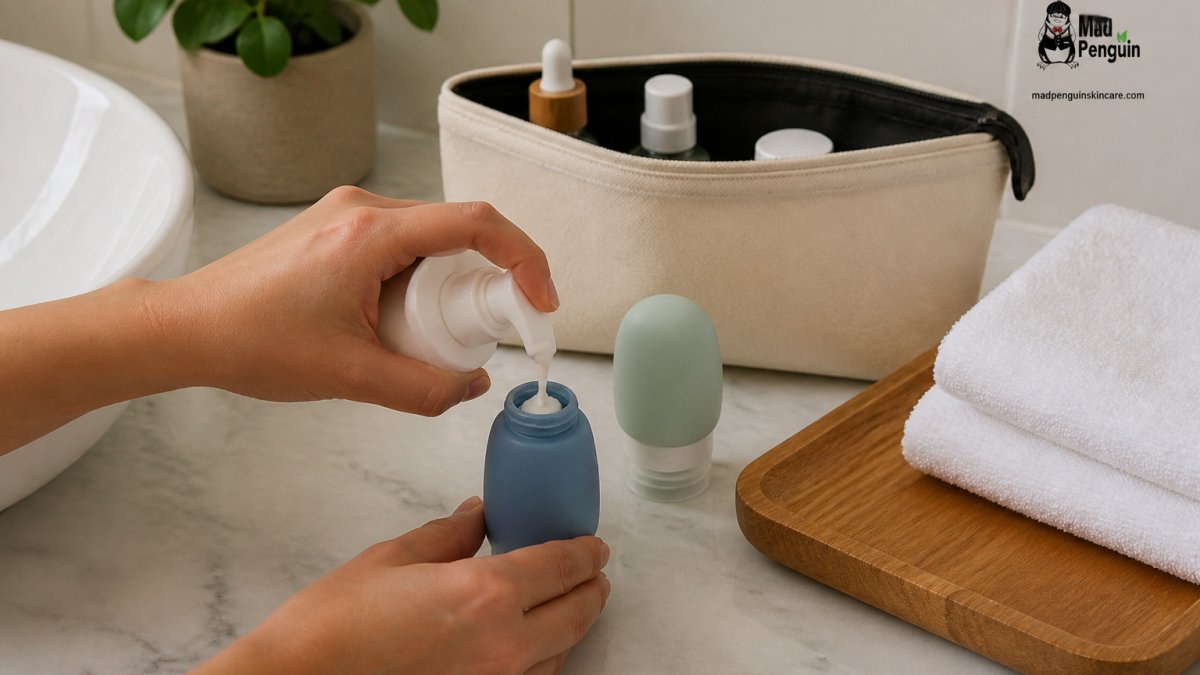
Reusable travel containers for skincare can replace many single-use minis over a year, and you control exactly what goes inside them. But the swap only pays off if you refill safely, a contaminated container can spoil a whole batch of product and send it to the trash anyway.
Here is a safe-refill protocol to follow:
- Clean and dry first. Wash containers with warm soapy water, rinse thoroughly, and let them air-dry completely, at least four hours, or overnight. Moisture left inside can encourage bacteria growth.
- Sanitize if reusing for a different product. A quick swish of isopropyl alcohol (70% or higher) and a full air-dry can help before switching from a cream to a serum.
- Label everything. Date and name each container. A blank amber bottle of "something" gets tossed, not used. Use a strip of masking tape and a permanent marker, it peels off cleanly for the next trip.
- Fill to about 80%. Liquids expand with cabin pressure changes. Headspace prevents leaks in your beauty bag. For very thin formulas (toners, essences), fill to 70% and squeeze the bottle slightly before capping to create a vacuum seal.
- Keep the original. Leave the full-size bottle at home and travel with the decanted amount only. Note the batch or expiration date on your label so you know how long the decanted portion is good for.
- Match container material to formula. Silicone bottles are squeezable and suit thicker creams and cleansers; rigid PET or glass jars suit balms and solid bars.
Watch out: decanting a product into an unlabeled container and then forgetting what's in it is how half-used formula ends up in the trash. Label it the day you fill it. And never top off a partially used travel bottle with fresh product, mix old and new and you risk introducing bacteria to the whole batch.
Airline rules matter here too. The TSA 3-1-1 rule limits carry-on liquids to containers of 3.4 ounces (100 ml) or less, all fitting in one quart-sized clear bag. Reusable containers sized at 1-3 ounces keep you compliant while letting you pack exactly what you need. Check your airline's baggage page before you fly, since enforcement and bag-size details can vary by carrier.
If you're clearing out old minis and tubes, how to recycle beauty product packaging walks through what can actually go in the bin.
Build a Minimalist Travel Skincare Routine
A minimalist travel skincare routine is a short, repeatable sequence you can run in any bathroom, in under five minutes, using only what you packed. The goal isn't fewer steps for their own sake. It's fewer products that each earn their place.
Here's a routine that holds up on a red-eye and a beach week alike:
- Cleanse with a gentle facial cleanser, morning and night.
- Hydrate with a moisturizer while skin is still slightly damp.
- Protect with sunscreen every morning, even on cloudy days.
- Repair at night with a richer cream if the air is dry.
Notice what's missing: toners, essences, sheet masks, and the ten-step sequence. On the road, those add weight and waste without adding much.
The test for any product you're considering: will you use it at least three times on this trip? If not, leave it home.
If you want to carry this pared-back approach past the trip itself, our guide on building a sustainable skincare routine covers how to keep it going at home.
Try Solid Skincare Products for Travel
Solid skincare products for travel are bar cleansers, solid moisturizer sticks, and concentrated formats that contain little or no water. That matters for two reasons: they skip the liquid restrictions at security, and they skip the plastic bottle entirely.
A solid facial cleanser in a paper wrap or a reusable tin produces no bottle waste.
The trade-offs are real, though. Solid formats can feel different on the skin, and some take a few uses to get used to. If your skin is sensitive, patch-test any new bar at home before you rely on it for a week away.
Skin sensitivity is the biggest reason people abandon a low-waste swap. Introduce one solid product at a time, not three at once, so you know what's working.
To understand which packaging claims actually hold up, what makes eco-friendly packaging truly sustainable breaks down the difference between marketing language and real material choices.
Plan Product Quantities by Trip Length and Handle Leftovers Well
Quantity planning is where most waste happens, and it's the easiest thing to fix. The rule of thumb: pack for the days you'll be gone, plus one. That buffer covers a delayed flight or an extra night without forcing you to buy a replacement mini at hotel-gift-shop prices.
Use this guide to estimate fill amounts for different trip lengths. The numbers assume twice-daily use for cleanser and moisturizer, and once-daily sunscreen application:
| Trip Length | Cleanser | Moisturizer | Sunscreen | Container Size |
|---|---|---|---|---|
| Weekend (2-3 days) | 15 ml | 15 ml | 30 ml | 1 oz jars |
| One week | 30 ml | 30 ml | 60 ml | 1-2 oz bottles |
| Two weeks+ | 50 ml | 50 ml | 90 ml | 2-3 oz refillables |
A few practical notes on those numbers. A 1 oz (30 ml) bottle is roughly six teaspoons, enough for about a week of twice-daily moisturizer for most faces.
Solid formats change the math. A solid cleanser bar can last many washes, depending on size and use. That's the quiet advantage of going solid: you plan in uses, not milliliters.
Now the harder question: what happens to leftovers?
- Bring them home. Decanted products go back into the bottle they came from. Wipe the thread of the travel container with a clean tissue before recapping to keep the seal tight.
- Use them up. A half-full moisturizer becomes your gym bag or desk drawer product. A nearly-empty serum can be finished on your hands and neck.
- Donate unopened items. Sealed, unused products may be accepted by some local shelters, call ahead to check, since many only accept unopened, unexpired items. Do not donate decanted or opened products; most organizations cannot accept them for hygiene reasons.
- Recycle the packaging correctly. Empty and rinse rigid plastic bottles and jars, then check your municipal recycling program, most curbside programs accept #1 and #2 plastics, but tubs and pumps often need a drop-off. how to recycle beauty product packaging covers the specifics.
- Never leave them in the hotel room. Housekeeping bins them, and that's pure waste. If you truly can't carry it home, ask the front desk about local donation options before you check out.
Watch out: decanting into a container that wasn't cleaned properly can introduce bacteria, especially with natural formulas that lack heavy preservative systems. Clean, dry, and label, every time.
For storage between trips, how to store natural skincare to keep it fresh covers temperature, light, and shelf life. And if you're building a low-waste kit from scratch, our Hydrating Skin Starter Kit at $48.00 gives you a cleanser and moisturizer worth decanting, with the full Healthy Skin Routine at $96.00 adding eye cream and overnight repair for longer trips.


Shop Mad Penguin Skincare for Your Low-Waste Travel Kit
Building a low-waste kit starts with products worth decanting. Our Hydrating Skin Starter Kit pairs a cleanser and a moisturizer for a travel routine. Our Hydrating Skin Starter Kit at $48.00 pairs our Hibiscus Scrub with the California Ocean Mineral Anti-Aging Moisturizer, so you get a cleanser and a moisturizer for a travel routine. The kit is designed for all skin types.
If you want the full set, our Healthy Skin Routine at $96.00 adds the antioxidant eye cream and the overnight repair cream. Decant what you need for the trip, leave the rest at home, and refill next time.
Travel will always tempt you toward the convenient, disposable option. The five choices above push back: pack less, refill instead of rebuy, go solid where you can, plan quantities, and deal with leftovers before they become trash.
Mad Penguin Skincare offers natural, non-toxic formulas for all skin types and eco-friendly, responsibly made skincare. Start with the Hydrating Skin Starter Kit, decant it into your reusable bottles, and travel with less waste and better skin.
Frequently Asked Questions
How can I reduce skincare waste while traveling?
Start by decanting your regular products into reusable travel containers instead of buying single-use minis. Pack only what you need for the trip length, choose multipurpose items like a scrub that also cleanses, and swap disposable facial cleansing wipes for a reusable cloth plus a small amount of facial cleanser. Bringing a refillable water bottle and refusing hotel samples you will not use also cuts plastic packaging waste.
Are reusable travel containers for skincare better than single-use minis?
Reusable containers cut single-use plastic and let you bring your exact formulas, which matters if your skin is sensitive to new products. Silicone or PP travel bottles in 30-100 ml sizes work well for cleanser, moisturizer, and serum. Wash and dry them fully between trips to prevent bacteria growth, and label each bottle so you do not mix up your night cream and eye cream.
Are solid skincare products for travel a good option?
Solid bars and balms skip liquid limits and plastic packaging, so they are handy for carry-on travel. They work best for cleansing and body care. If your skin needs a specific moisturizer or anti-aging formula, decant your regular product into a small reusable jar rather than switching formats mid-trip, since new formats can trigger irritation on sensitive skin.
What should I do with leftover skincare products after a trip?
Finish them at home rather than tossing half-used minis. If a product did not work for you, offer it to a friend or family member with similar skin, or check whether a local shelter accepts unopened, unexpired personal care items. Empty reusable containers should be washed, dried, and stored for the next trip so you are not buying new ones each time.
