
Last Updated: November 1, 2026
Quick Summary
The most common endocrine disruptors in beauty products are parabens, phthalates hidden in fragrance, PFAS, triclosan, and chemical UV filters like oxybenzone and octinoxate. They appear in lotions, shampoos, makeup, and sunscreens, where they can mimic, block, or alter hormone signaling. Fragrance is the highest-leverage category to rethink, since individual phthalates often hide behind the word parfum.
- Parabens such as methylparaben, propylparaben, and butylparaben are preservatives used to stop bacteria and mold growth.
- Fragrance can be listed collectively as fragrance or parfum, so phthalates like DEP may never appear by name.
- Ingredients are listed in descending order of concentration, so scan the first five to judge a flagged ingredient.
- Prioritize leave-on products worn longest, like foundation, before working outward to rinse-off items.
- Clean and non-toxic are marketing terms, not regulated standards, so look for third-party certifications instead.
Table of Contents
- What Are Endocrine Disruptors and Why They Matter in Beauty Products
- 1. Parabens in Beauty Products: The Preservative Under Scrutiny
- 2. Phthalates and Fragrance in Skin Care Products
- 3. Endocrine Disruptors in Makeup: Beyond Skin Care
- 4. PFAS, Triclosan, and Other Chemicals of Concern
- How to Read Cosmetic Ingredient Labels and Spot Red Flags
- Lower-Exposure Product Choices Without the 'Toxin-Free' Hype
- Shop Mad Penguin Skincare for Transparent, Low-Exposure Formulas
- Frequently Asked Questions
What Are Endocrine Disruptors and Why They Matter in Beauty Products
Endocrine disruptors are chemicals that can interfere with the body's hormone system, and research has found them in everyday cosmetics, lotions, shampoos, and sunscreens. This guide from Mad Penguin Skincare breaks down the most common endocrine disruptors in beauty products, how to spot them on a label, and how to lower your exposure without falling for marketing hype.
The stakes are real. A 2025 review in PubMed Central on personal care products as endocrine disruptors identifies hair and skin care, baby-care products, UV-blocking creams, facial cleansers, and insect products as categories that readily expose people to these chemicals. Meanwhile, the Harvard T.H. Chan Beauty Edit Study notes that chemicals in hair products have been linked to endocrine diseases that are more prevalent among Black, Hispanic, and Asian women and girls.
Here's the tension most guides skip: finding a chemical on an ingredient list does not, by itself, tell you the level of risk from that product. The National Institute of Environmental Health Sciences on endocrine disruptors describes these substances as suspected or potential disruptors and reports associations, not product-specific risk estimates. So the goal is proportionate reduction, not panic.
Below, we walk through seven chemical families, how to read labels like a skeptic, and how to choose lower-exposure products without buying into "toxin-free" claims.
How Endocrine Disruptors Interfere With Hormone Function
Endocrine-disrupting chemicals, often shortened to EDCs, can mimic, block, or alter hormone signaling in the body. Hormones act as chemical messengers, and even small interferences can affect how the hormone system regulates development, metabolism, and reproduction.
The research picture is one of association rather than certainty. A Medical Xpress report on a 2021 study described researchers quantifying internal levels of parabens and benzophenones among 124 women, with and without breast cancer. That kind of biomonitoring shows exposure is widespread. It does not prove a specific product caused a specific health effect.
What most guides miss is the difference between hazard and risk. A chemical can be flagged as a potential endocrine disruptor and still carry very different risk depending on dose, frequency, and route of exposure. That distinction should shape how you shop.
1. Parabens in Beauty Products: The Preservative Under Scrutiny
Parabens are preservatives used to stop bacteria and mold from growing in lotions, creams, and makeup, and they are among the most studied endocrine disruptors in beauty products. Names to look for include methylparaben, ethylparaben, propylparaben, and butylparaben.
Why do formulators use them? Because water-based products spoil fast, and preservatives keep them safe. A common mistake is assuming "paraben-free" automatically means better. The replacement preservative matters just as much, and some alternatives have their own question marks.
Parabens are a reasonable place to start reducing exposure, especially in leave-on products used daily. Treat any label claim as a starting point, not a finish line.
2. Phthalates and Fragrance in Skin Care Products
Phthalates are a family of chemicals used to make fragrances last longer and to soften plastics, and they are among the most common endocrine disruptors in beauty products. The ones most often discussed in personal-care research include diethyl phthalate (DEP), dibutyl phthalate (DBP), diethylhexyl phthalate (DEHP), and dimethyl phthalate (DMP).
The labeling problem is structural, not accidental. Fragrance can often be listed collectively as "fragrance" or "parfum," so individual phthalates may not appear by name. To understand what those hidden fragrance chemicals may do, see synthetic fragrance side effects.
Here is where evidence grading matters, because most guides flatten everything into one alarm. The National Institute of Environmental Health Sciences describes phthalates as suspected endocrine disruptors and reports associations with effects on development and reproduction in animal and human studies. That is established enough to warrant attention.
Exposure also varies far more than the ingredient list suggests. A rinse-off cleanser used for thirty seconds is a different exposure pathway than a leave-on lotion applied twice daily to large areas of skin. A fragrance mist sprayed near the face is different again. Frequency, amount, and route matter as much as presence.
A common pattern in lower-exposure routines is to prioritize fragrance in leave-on products first, then work outward to rinse-off items. "Fragrance-free" and "unscented" are not the same claim, unscented can mean a masking fragrance was added, so read the ingredient list rather than the front of the bottle.
3. Endocrine Disruptors in Makeup: Beyond Skin Care
Endocrine disruptors in makeup deserve their own attention because makeup is often worn for long stretches and reapplied daily. Foundations, lip products, and long-wear formulas can carry preservatives, fragrance, and UV filters, sometimes all in one product.
The practical move is to prioritize. A lipstick you wear twice a week is a smaller exposure source than a foundation you wear eight hours a day. Start with the products that stay on your skin longest, then work outward.
- Long-wear foundation and concealer: check preservatives and fragrance
- Lip products: fragrance and flavor ingredients
- Setting sprays: often carry fragrance and alcohol
- Mascara and eyeliner: preservatives matter most here
4. PFAS, Triclosan, and Other Chemicals of Concern
PFAS, short for per- and polyfluoroalkyl substances, are persistent chemicals sometimes called "forever chemicals" because they resist breakdown. They show up in discussions of cosmetics largely because of their grease-repelling and water-repelling properties, which can make products feel smooth and long-lasting.
Triclosan is an antibacterial ingredient that has appeared in soaps and some personal-care items. A 2026 review highlighted by ScienceDirect on endocrine disruptors in personal care products names parabens, phthalates, bisphenols, and oxybenzone among commonly encountered endocrine-disrupting chemicals in cosmetics. Oxybenzone, a common chemical UV filter in sunscreens, remains a focus in sunscreen ingredient discussions.
Watch out: this is the category where fear-based marketing runs hottest. Judge products on what they actually contain, not on slogans.
How to Read Cosmetic Ingredient Labels and Spot Red Flags
Reading a cosmetic ingredient label well means knowing that ingredients are listed in descending order of concentration, with the highest amounts first. That single fact lets you judge whether a flagged ingredient is a major component or a trace presence near the bottom.
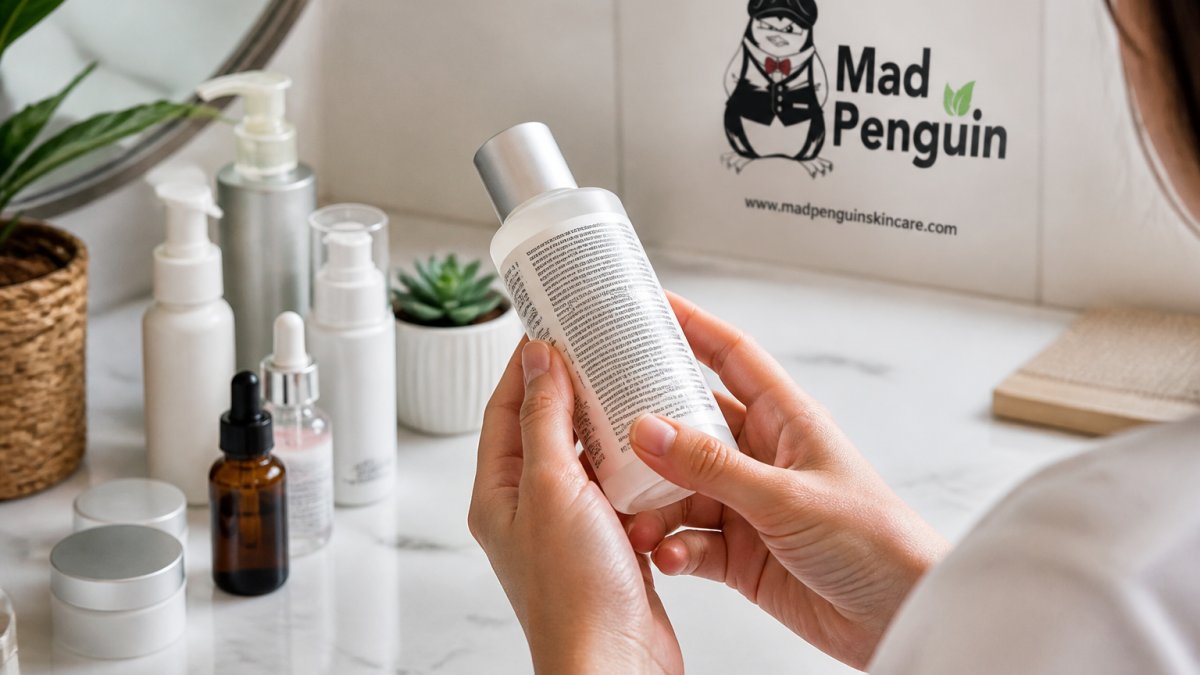
The harder problem is that the same chemical can appear under several names, and the label rarely tells you what function it serves. This lookup table maps common endocrine-disruptor names, their synonyms, and what they do in a formula, so you can act at the point of purchase.
| Ingredient on label | Also appears as | Function in product |
|---|---|---|
| Methylparaben | Methyl 4-hydroxybenzoate; E218 | Preservative |
| Propylparaben | Propyl 4-hydroxybenzoate; E216 | Preservative |
| Butylparaben | Butyl 4-hydroxybenzoate | Preservative |
| Diethyl phthalate | DEP; phthalic acid diethyl ester | Fragrance fixative, denaturant |
| Dibutyl phthalate | DBP | Plasticizer, nail-product solvent |
| Oxybenzone | Benzophenone-3; BP-3 | Chemical UV filter |
| Octinoxate | Ethylhexyl methoxycinnamate | Chemical UV filter |
| Triclosan | 5-chloro-2-(2,4-dichlorophenoxy)phenol | Antibacterial |
| Bisphenol A | BPA | Plasticizer in packaging, rarely listed |
| PFAS | PTFE; perfluorooctyl triethoxysilane | Water and grease repellent |
Here is how we would work through a label:
- Scan the first five ingredients. These make up most of the formula.
- Circle any fragrance or parfum entry, since it can stand in for undisclosed fragrance ingredients.
- Cross-check unfamiliar names against the table above and an ingredient database, because synonyms hide the same chemical. For a practical walkthrough, read how to identify non-toxic skincare ingredients.
- Note "leave-on" versus "rinse-off." Leave-on products stay in contact with skin longer.
- Check for third-party certifications rather than trusting front-of-bottle claims.
One caution on the table: finding a name on it does not by itself tell you the risk from that product. Presence is not the same as dose, and the National Institute of Environmental Health Sciences frames these as suspected or potential disruptors rather than proven product-level hazards. Use the table to recognize and prioritize, not to panic.
Lower-Exposure Product Choices Without the 'Toxin-Free' Hype
Choosing lower-exposure products is about reducing cumulative chemical exposure, not chasing a "toxin-free" label that no regulator defines. "Clean" and "non-toxic" are marketing terms, not regulated standards, so they tell you almost nothing on their own. Before choosing products, learn how to identify greenwashing in skincare.
A better approach is to look for specific, verifiable signals:
- Full ingredient disclosure, including fragrance components
- Recognized third-party certifications rather than self-declared claims
- Shorter ingredient lists in leave-on products
- Clear statements about what a brand does and does not use
One honest limitation: no product can promise zero exposure. What you can do is make informed, cumulative reductions across the products you use most.
Shop Mad Penguin Skincare for Transparent, Low-Exposure Formulas
At Mad Penguin Skincare, our formulas are built around natural, non-toxic ingredients and are free from synthetic chemicals and harsh additives, for all skin types. Visit the Mad Penguin Skincare website to explore the range.
If you are ready to make the switch, Mad Penguin Skincare's website is a good place to start building a low-tox routine. For a step-by-step plan, see how to transition to low-tox skincare. A few of our products that fit a lower-exposure routine:
- Goodbye Puffy Eyes natural antioxidant eye cream for the delicate eye area
- California Ocean Mineral Anti-Aging Moisturizer for daily hydration
- Night's Best Friend Overnight Repair Cream for overnight recovery
- L.A. Hibiscus natural face scrub for gentle exfoliation
| Your Goal | What to Look For | Mad Penguin Product |
|---|---|---|
| Reduce fragrance exposure | Fragrance-free formulas | Night's Best Friend Overnight Repair Cream |
| Daily hydration | Short, transparent ingredient lists | California Ocean Mineral Anti-Aging Moisturizer |
| Gentle exfoliation | Natural scrubs over synthetic beads | L.A. Hibiscus natural face scrub |
| Eye-area care | Antioxidant support | Goodbye Puffy Eyes eye cream |
Reducing your exposure to common endocrine disruptors in beauty products does not require a cabinet overhaul or a chemistry degree. It requires knowing which categories matter most, reading labels with a skeptical eye, and choosing brands that disclose what they put in the bottle.
Mad Penguin Skincare makes that easier with natural, non-toxic ingredients, clean formulas free from synthetic chemicals and harsh additives, and eco-friendly, responsibly made products for all skin types. Visit the Mad Penguin Skincare website to explore products and build a routine you can feel confident about.
Frequently Asked Questions
What are some examples of endocrine-disrupting chemicals found in makeup?
Common examples include parabens, phthalates, bisphenols, oxybenzone, and synthetic musks like tonalide and galaxolide. Published reviews name parabens, phthalates, bisphenols, and oxybenzone among commonly encountered endocrine disruptors in personal-care products and cosmetics. These chemicals serve as preservatives, plasticizers, UV filters, and fragrance fixatives, which is why they appear across foundations, lotions, sunscreens, and perfumes.
Are parabens in beauty products endocrine disruptors?
Parabens are preservatives used to prevent mold and bacteria growth, and they are among the most studied endocrine disruptors in beauty products. Biomonitoring research has measured internal levels of parabens and benzophenones in people. The presence of a chemical does not by itself establish a specific health risk, but readers who want to reduce exposure can look for paraben-free formulas and check labels for methylparaben, propylparaben, and butylparaben.
Can fragrance in skin care products contain phthalates?
Yes. Phthalates are often used to help fragrance linger, and they may be hidden under the catch-all terms fragrance or parfum. Because fragrance ingredients are not always disclosed individually, choosing products that state phthalate-free or fragrance-free on the label is a practical way to lower exposure.
How can I check whether a beauty product contains potential endocrine disruptors?
Start by reading the ingredient list and looking for parabens (methyl-, propyl-, butyl-), phthalates (often listed as DEP or DBP), oxybenzone, triclosan, and synthetic musks such as tonalide and galaxolide. Check whether fragrance or parfum appears without further detail, since that can conceal phthalates. You can also look for third-party testing or certifications and visit the Mad Penguin Skincare website to review its ingredient information.
