

Table of Contents
- Why Non-Toxic Skincare Matters for Your Skin Barrier
-
How to Read Skincare Labels: A Step-by-Step Workflow
- Step 1: Find the INCI List and Check the First Five Ingredients
- Step 2: Decode Chemical Nomenclature and Spot Greenwashing Terms
- Step 3: The Greenwashing Dictionary, Decode Marketing Buzzwords
- Step 4: Use a Real-Time Decision Flowchart
- Step 5: Ingredient Synergy and Concentration, Why Presence Doesn't Equal Toxicity
- Toxic Ingredients to Avoid in Skincare: What the Evidence Shows
- Using a Clean Beauty Ingredient Checker Without Relying on Fear
- Ingredient Synergy, Concentration, and Preservative Systems
- Regulatory Reality: What Product Safety Standards Actually Cover
- Putting It Into Practice: A Simple Non-Toxic Skincare Routine
- Conclusion
- Frequently Asked Questions
Last Updated: September 16, 2026
Why Non-Toxic Skincare Matters for Your Skin Barrier
Your skin barrier is a living, semi-permeable shield: the stratum corneum keeps water in and irritants out. When harsh surfactants, synthetic fragrance, or certain preservatives disrupt that layer, you get tightness, redness, flaking, and reactivity.
At Mad Penguin Skincare, clean formulas free from synthetic chemicals and harsh additives aren't a marketing angle; they're the baseline for supporting healthy, hydrated skin.
The term non-toxic skincare describes products formulated without ingredients linked to irritation, hormone disruption, or long-term health concerns, with transparency about what's inside the bottle. It doesn't mean "chemical-free" (water is a chemical); it means the chemicals present are chosen for safety at the concentrations used.
Fear-based marketing has muddied the water. Below: a repeatable label-reading workflow, the ingredients worth scrutinizing, and how to check a product without outsourcing your judgment to an app.
How to Read Skincare Labels: A Step-by-Step Workflow
Reading a skincare label well is a skill, not a talent. The workflow below takes about two minutes per product once practiced.
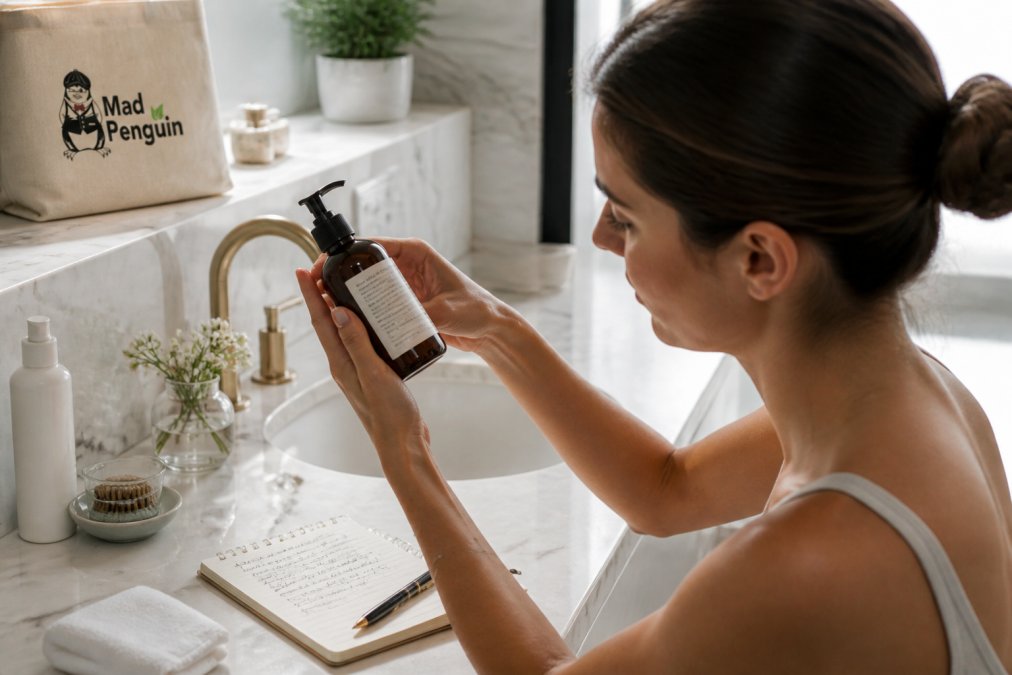
Step 1: Find the INCI List and Check the First Five Ingredients
The INCI list is the International Nomenclature of Cosmetic Ingredients, the standardized naming system required on cosmetic labels. Ingredients appear in descending order of concentration down to 1%, then in any order.
Those first five entries tell you what the product mostly is. If water, glycerin, and a botanical oil lead the list, you're looking at a hydrating base. If denatured alcohol or synthetic fragrance sits near the top, think harder.
Step 2: Decode Chemical Nomenclature and Spot Greenwashing Terms
Chemical names look intimidating but follow patterns. "Sodium" plus a fatty acid usually signals a soap or surfactant. "-paraben," "-phthalate," and "-siloxane" endings flag families worth knowing.
Greenwashing is the bigger trap. Words like "natural," "botanical," and "plant-based" have no legal definition in cosmetics. A product can be 98% water, preservative, and fragrance and still call itself natural. Watch for vague phrases like "preservative blend" or "fragrance (parfum)," which can hide dozens of undisclosed compounds.
Step 3: The Greenwashing Dictionary, Decode Marketing Buzzwords
Most guides stop at "avoid these ingredients." The real skill is spotting terms that imply safety without certification:
| Buzzword | What It Implies | What It Actually Means |
|---|---|---|
| "Clean" | Free from toxins | No legal definition; brand-defined |
| "Natural" | Plant-derived, safe | No legal definition; can include synthetic processing |
| "Botanical" | Plant-based | May be a tiny amount of plant extract in a synthetic base |
| "Chemical-free" | No synthetic chemicals | Impossible; water is a chemical |
| "Dermatologist-tested" | Safe for skin | Not a safety standard; may mean tested on a few people |
| "Hypoallergenic" | Won't cause allergies | No FDA standard; self-reported |
| "Non-toxic" | Safe ingredients | No legal definition; brand-defined |
When you see these terms, look for third-party certifications like USDA Organic, EWG Verified, or Leaping Bunny.
Step 4: Use a Real-Time Decision Flowchart
A simple mental flowchart for evaluating a product in the store:
- Scan the first five ingredients. Mostly water, glycerin, and recognizable oils? Continue. Alcohol or fragrance in the top five? Put it down.
- Look for red-flag families. Parabens, phthalates, sulfates, synthetic fragrance, note the concentration context (leave-on vs. rinse-off).
- Check for greenwashing terms. A "natural" front label with synthetic preservatives on the back is a mismatch.
- Look for certifications. USDA Organic, EWG Verified, or Leaping Bunny are third-party verified. If none, proceed with caution.
- Consider your skin type. A product fine for oily skin may be too rich for acne-prone skin.
Step 5: Ingredient Synergy and Concentration, Why Presence Doesn't Equal Toxicity
An ingredient's effect depends on what it's paired with and how much is present. Bioavailability (how much actually penetrates skin) shifts with molecular size, pH, and the surrounding formula.
Toxic Ingredients to Avoid in Skincare: What the Evidence Shows
No single ingredient is poison in every context; dose, concentration, and your individual skin matter. That said, a handful of ingredient families have enough research behind them that cautious shoppers tend to avoid them, especially in leave-on products.
Parabens, Phthalates, and Endocrine Disruptors
Endocrine disruptors are substances that can interfere with hormone signaling. Parabens (methyl-, propyl-, butyl-) are preservatives with weak estrogen-like activity in lab studies. Phthalates, often hidden inside "fragrance," are plasticizers linked to reproductive concerns in animal research. Neither belongs in a product you apply daily if you can avoid it.
Sulfates, Silicones, and Synthetic Fragrance
Sulfates like sodium lauryl sulfate strip oil aggressively, which is fine for dish soap and rough on a compromised barrier. Silicones (dimethicone, cyclopentasiloxane) aren't toxic, but they can trap debris and create a false smoothing effect that masks dryness. Synthetic fragrance is the single most common cause of allergic contact dermatitis in cosmetics, which is why fragrance-free beats "unscented" every time.
| Ingredient Family | Common Label Names | Why People Avoid It | Safer Swap |
|---|---|---|---|
| Parabens | methylparaben, propylparaben | Hormone-signaling concerns | Phenoxyethanol, sodium benzoate |
| Phthalates | diethyl phthalate (in "fragrance") | Reproductive concerns in animal studies | Fragrance-free formulas |
| Sulfates | SLS, SLES | Strips skin barrier | Cocamidopropyl betaine |
| Silicones | dimethicone, cyclomethicone | Traps debris, masks dryness | Plant oils, squalane |
| Synthetic fragrance | parfum, fragrance | Allergic contact dermatitis | Essential-oil-free botanicals |
Using a Clean Beauty Ingredient Checker Without Relying on Fear
A clean beauty ingredient checker is a database or app that flags ingredients against safety ratings. Used well, it saves time. Used badly, it turns every unfamiliar word into a red flag.
Ingredient Synergy, Concentration, and Preservative Systems
Here's what most guides miss: an ingredient's effect depends on what it's paired with and how much is present. Bioavailability (how much actually penetrates skin) shifts with molecular size, pH, and the surrounding formula.
Regulatory Reality: What Product Safety Standards Actually Cover
In the United States, cosmetics are regulated by the FDA under the Federal Food, Drug, and Cosmetic Act. The FDA does not pre-approve cosmetic ingredients or finished products before they hit shelves, with the exception of color additives. That surprises most people.
FDA vs. Third-Party Standards: What's the Difference?
The FDA's role is limited. It doesn't test ingredients for safety before they're sold; it relies on manufacturers to self-report and substantiate safety. The burden of proof is on the brand, not the regulator.
How to Use Regulatory and Third-Party Information
When evaluating a product, consider both FDA compliance and third-party certifications. A product that meets FDA labeling requirements but lacks third-party verification isn't necessarily unsafe, but it hasn't been independently vetted. A product with EWG Verified or USDA Organic has met additional standards.
The Bottom Line on Regulatory Reality
Understanding the difference between FDA regulations and third-party standards helps you manage expectations. The FDA sets baseline rules for labeling and safety substantiation, but doesn't guarantee ingredient safety. Third-party certifications add assurance, but aren't perfect either. The best approach combines regulatory awareness with label-reading skills and a critical eye for greenwashing.
Putting It Into Practice: A Simple Non-Toxic Skincare Routine
You don't need fifteen products. You need four that work and that you can read.
Conclusion
The hardest part of switching to non-toxic skincare isn't finding clean products; it's learning to read a label without panicking or trusting a green leaf icon. Once you can scan an INCI list, spot greenwashing language, and weigh concentration over hazard scores, you stop needing someone else's verdict.
Frequently Asked Questions
How can I check if my skincare products contain toxic ingredients?
Start with the INCI list on the back of the package. Scan for parabens (methylparaben, propylparaben), phthalates (often hidden under 'fragrance'), formaldehyde releasers like DMDM hydantoin, and synthetic fragrance. Cross-check the first five ingredients, since those make up most of the formula. A clean beauty ingredient checker app can flag hazards, but treat it as a starting point, not a verdict. Manufacturer safety data sheets and product safety standards give fuller context than any single database score.
What are the top ingredients to avoid in skincare products?
The most cited toxic ingredients to avoid in skincare include parabens, phthalates, sulfates (SLS and SLES), silicones, synthetic fragrance, formaldehyde releasers, and endocrine disruptors like certain UV filters. The concern isn't one exposure but cumulative daily use across multiple products. That said, concentration and formulation matter. A preservative at 0.1% in a water-based cream behaves very differently from the same compound at higher doses, so read labels with context rather than panic.
What is the difference between clean, natural, and organic skincare?
'Natural' has no legal definition in cosmetics, so any brand can print it. 'Organic' usually means USDA-certified organic agricultural ingredients, verified through the National Organic Program. 'Clean beauty' is a marketing umbrella that generally means avoiding a brand's own do-not-use list. None of these guarantee safety or efficacy. What matters is ingredient transparency, the actual INCI list, and whether the brand publishes third-party testing or certifications you can verify.
Are there apps that help identify toxic skincare ingredients?
Yes. Apps like Think Dirty, EWG's Healthy Living, and INCI Decoder let you scan a barcode or paste an ingredient list and see hazard ratings. They're useful for label literacy, but their scoring systems vary and often flag ingredients at concentrations far below any real risk. Use them to learn chemical nomenclature, not as a final judge. Pair app results with the brand's own safety data and published product safety standards before deciding.