

Table of Contents
- Why Clean Beauty Products Cause Breakouts
- Comedogenic Ingredients List: What to Avoid
- Skin Purging vs. Breakout: How to Tell the Difference
- How to Identify Acne-Safe Clean Beauty Brands
- Patch Testing Protocols and Transition Strategies
- Building a Breakout-Free Clean Skincare Routine
- Frequently Asked Questions
Last Updated: September 19, 2026
Why Clean Beauty Products Cause Breakouts
The "clean beauty" movement promises safer, gentler skincare. Yet many people who switch to natural products experience the opposite: more breakouts, congestion, and irritation. At Mad Penguin Skincare, we understand the concerns around why clean beauty products can sometimes cause breakouts and what actually separates effective clean formulas from ones that wreak havoc on your skin.
The problem isn't that natural ingredients are inferior, it's that the "clean" label has become meaningless marketing. Many clean formulas contain ingredients that actively clog pores, trigger sensitivity, or disrupt your skin barrier.
Not every natural ingredient is skin-safe, and not every reaction to a new product means the formula is bad, sometimes your skin is purging, which is temporary and different from a breakout.
The Myth vs. Reality of 'Clean' Labels
"Clean beauty" doesn't have a legal definition. The FDA doesn't regulate it. No independent body certifies what qualifies as clean. Brands self-define the term, which means one company's "clean" formula might contain ingredients another company explicitly avoids.
A product can be labeled clean while containing comedogenic oils, fragrance compounds, or essential oils that trigger inflammation. The label tells you nothing about whether the formula will work for your skin.
"Natural" and "safe" are not synonyms. Lavender essential oil is natural but a known irritant for many people. The ingredient source matters far less than how it behaves on your specific skin.
How Ingredient Sensitivity Differs from Product Quality
Your skin reacts to individual ingredients, not marketing labels. Two people can use the same formula and experience completely different results.
Skin sensitivity is personal, your microbiome, pH balance, and genetic predisposition determine which ingredients will work. A high-quality clean formula can still cause breakouts if it contains an ingredient your skin can't tolerate.
A breakout doesn't always mean the product is low-quality, sometimes it's just not right for you, or your skin is purging temporarily.
Comedogenic Ingredients List: What to Avoid
Comedogenic means pore-clogging, high-rated ingredients block sebum flow, trapping bacteria and dead skin cells beneath the surface.
Comedogenicity is a spectrum. If your skin is acne-prone, avoiding high-comedogenic ingredients improves your chances of clear skin.
Natural Oils That Clog Pores
Plant oils are staples in clean beauty, but many are highly comedogenic.
Coconut oil ranks high on the comedogenic scale. Despite its reputation, it clogs pores for most acne-prone skin by trapping moisture underneath.
Sesame oil, wheat germ oil, and avocado oil are similarly problematic, rich in oleic acid, which is nourishing but pore-clogging.
Jojoba oil and squalane are lower on the comedogenic scale and absorb better than heavier oils.
Many buy "natural moisturizers" loaded with coconut oil and wonder why their skin worsens. Mad Penguin Skincare's California Ocean Mineral Anti-Aging Moisturizer hydrates without pore-clogging oils.

Essential Oils and Fragrance Sensitivity
Essential oils are highly concentrated compounds that irritate many people's skin, despite being marketed as natural alternatives to synthetic fragrances.
Lavender, tea tree, lemon, and eucalyptus oils are common in clean beauty but frequent triggers for sensitivity, contact dermatitis, and inflammation.
Both synthetic and essential oil fragrances can irritate your skin barrier and trigger inflammation, though people assume natural means gentle.
Fragrance-free formulas exist, and they're often the safest choice for acne-prone skin. If a product is labeled "unscented," check the ingredients. Unscented products can still contain fragrance compounds masked by other scents. True fragrance-free products list no fragrance ingredients at all.
Skin Purging vs. Breakout: How to Tell the Difference
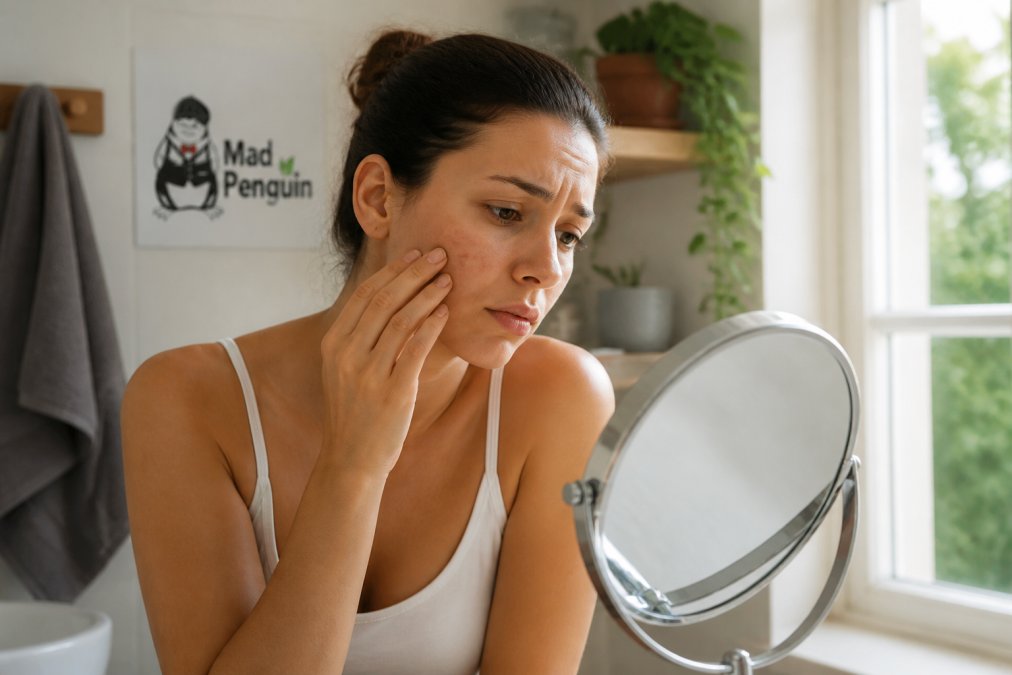
When you switch to a new clean product and break out, you might assume the product is causing damage. Sometimes your skin is purging instead, a temporary process where new actives accelerate cell turnover.
Purging is a sign the product is working; breakouts signal irritation or ingredient intolerance.
Signs Your Skin Is Purging
Purging occurs in areas where you already break out. It doesn't randomly appear in new zones.
Purging lasts 2-6 weeks maximum, then breakouts should decrease noticeably.
Purging breakouts are typically smaller and less inflamed, whiteheads and small papules, not deep cystic ones.
The product contains active ingredients that accelerate cell turnover. Retinoids, acids, and vitamin C can trigger purging; basic moisturizers cannot.
Signs You're Having an Actual Breakout
Breakouts appear in new areas where you never break out, a sign of irritation, not purging.
Breakouts intensify after week 6, a sign your skin isn't tolerating the product.
You experience itching, burning, or stinging. These are signs of irritation or an allergic reaction, not purging. Your skin barrier is being damaged.
The breakouts are deep, cystic, or severely inflamed. Purging typically produces surface breakouts. Severe inflammation suggests a true adverse reaction.
You're using a product with no active ingredients. A cleanser, moisturizer, or oil cannot cause purging. If you break out after using it, the product contains an ingredient your skin can't tolerate.
How to Identify Acne-Safe Clean Beauty Brands
Not all clean beauty brands are equal. Some prioritize ingredient safety for acne-prone skin. Others use the clean label as marketing while ignoring comedogenicity.
What 'Acne-Safe' Actually Means
A truly acne-safe product avoids high-comedogenic ingredients, fragrance (synthetic or essential oil), and common irritants. It's formulated with non-comedogenic hydrators and ingredients that support your skin barrier without clogging pores.
Acne-safe doesn't mean the product contains no oils. It means the oils used are lower on the comedogenic scale and present in concentrations that won't block pores. Acne-safe also doesn't mean the product will cure your acne. It means the formula won't make breakouts worse.
Reading Labels for Non-Comedogenic Formulas
Start with the ingredient list. If the first three ingredients are coconut oil, sesame oil, or avocado oil, the product is not designed for acne-prone skin, regardless of the marketing claims.
Look for hydrators like glycerin, hyaluronic acid, and ceramides. These moisturize without clogging pores. Look for non-comedogenic oils like squalane or jojoba if oils are included.
Check for fragrance. If the label lists "fragrance," "parfum," or any essential oil (lavender, tea tree, lemon), the product is not fragrance-free. True acne-safe formulas are fragrance-free.
Scan for salicylic acid (BHA) or niacinamide, which help prevent congestion. These ingredients actively work against breakout formation, not just avoid causing them.
Mad Penguin Skincare's approach focuses on clean formulas designed to be effective for various skin types. The Hydrating Skin Starter Kit includes the L.A. Hibiscus natural face scrub, which gently exfoliates without relying on pore-clogging oils, and the California Ocean Mineral Anti-Aging Moisturizer, formulated to hydrate without comedogenic ingredients.


Patch Testing Protocols and Transition Strategies
The safest way to introduce a new skincare product is through patch testing. This simple process prevents full-face reactions and helps you identify problematic ingredients before they cause widespread breakouts.
How to Patch Test Before Full Use
Choose a small, inconspicuous area. The inside of your forearm or behind your ear works well. These areas are sensitive enough to show reactions but hidden enough that you won't feel self-conscious if irritation appears.
Apply a small amount of the product. Use about the size of a rice grain. Rub it in gently and leave it on for 24 hours without washing that area.
Wait and observe. Check the area after 24 hours. Look for redness, itching, swelling, or a rash. If nothing appears, the product is likely safe for your skin.
If the patch test passes, apply to a small facial area. Use the product on a quarter of your face for 3-5 days. Watch for any signs of irritation or breakouts in that zone.
Only then move to full-face application. If your skin tolerates the product on a small area, you can safely use it all over your face.
Transitioning Gradually from Conventional to Clean
If you're switching from conventional skincare to clean formulas, your skin needs time to adjust. Doing it all at once often triggers a reaction that feels like the clean products are causing breakouts, when really, your skin is struggling with the transition.
Building a Breakout-Free Clean Skincare Routine
A simple routine with the right products beats a complex routine with the wrong ones. The goal is to cleanse, hydrate, and protect your skin barrier without introducing breakout triggers.
Start Simple with Essential Steps
A minimal routine has three steps: cleanse, hydrate, and protect (with SPF during the day).
Layer Products Strategically
If you want to add more products, a serum, an exfoliant, a treatment, layer them in the right order to maximize absorption and minimize irritation.
| Routine Step | Product Type | Frequency | Purpose |
|---|---|---|---|
| Cleanse | Gentle cleanser or scrub | 2x daily | Remove impurities and dead skin |
| Hydrate | Non-comedogenic moisturizer | 2x daily | Support skin barrier and hydration |
| Treat | Targeted serum or exfoliant | 3-5x weekly | Address specific skin concerns |
| Protect | SPF | Daily (AM) | Prevent sun damage and inflammation |
Frequently Asked Questions
Why does my face break out when I switch to clean beauty products?
Breakouts from clean beauty products typically occur due to three reasons: ingredient sensitivity to natural oils or essential oils, skin purging as your skin adjusts to active ingredients, or the product simply being comedogenic for your skin type. Not all clean formulas work for all skin, what matters is finding acne-safe clean beauty brands that use non-comedogenic ingredients. Patch testing before full application helps identify sensitivity before breakouts spread.
How can I tell the difference between skin purging and a breakout?
Skin purging occurs in areas where you normally break out, appears after introducing active ingredients, and typically clears within 4-6 weeks. A true breakout from an incompatible product spreads to new areas, causes inflammation or itching, and persists beyond 6 weeks. Understanding skin purging vs. breakout helps you decide whether to continue or discontinue a product. If you're unsure, patch test on a small area first and monitor for 2-3 weeks.
What does 'acne-safe' actually mean when shopping for clean beauty?
Acne-safe means the product is formulated to be non-comedogenic, free from pore-clogging ingredients, and designed not to trigger breakouts in acne-prone skin. However, 'acne-safe' is not a regulated term, brands self-designate it. Look for ingredient transparency and consider patch testing before committing to a full routine.