

Last Updated: November 7, 2026
Quick Summary
To reduce waste in DTC beauty, audit every packaging and shipping component, switch to single-material or refillable formats, and track packaging weight per order monthly. Designing for recyclability and avoiding mixed-material pumps keeps materials out of landfill.
- List and weigh every component leaving your warehouse, including mailers, void fill, and inserts.
- Choose single-material containers like glass jars with aluminum lids over mixed-material pumps.
- Refill pods only cut material use when the pod itself is lightweight and the outer container is reused.
- Set a baseline for grams of packaging per order and track it monthly by product type.
- Track return rate alongside packaging weight, since returns generate extra packaging and shipping waste.
Table of Contents
- The Environmental Impact of the Beauty Industry and What DTC Brands Can Change
- Beauty Industry Plastic Waste: Where Packaging Ends Up
- Tips for Reducing Waste in the Beauty Industry: A Practical Roadmap
- Packaging End-of-Life and Recycling Realities for DTC Beauty
- Building an Eco-Friendly Skincare Routine That Cuts Waste
- How Mad Penguin Skincare Puts Low-Waste Beauty Into Practice
- Start Your Low-Waste Skincare Switch with Mad Penguin
- Frequently Asked Questions
The Environmental Impact of the Beauty Industry and What DTC Brands Can Change
The beauty industry's environmental footprint is large, and it's growing. Research on circular economy practices in the cosmetics industry shows that circular approaches like recycling, refilling, and reusing materials can systematically cut waste. At Mad Penguin Skincare, we built our line around one belief: you shouldn't have to choose between results and responsibility.
Reduce waste is the simplest place to start. It means using less material, reusing what you can, and recycling what's left. For DTC beauty, that shift touches packaging, shipping, formulas, and how customers use products at home.
Beauty Industry Plastic Waste: Where Packaging Ends Up
Beauty industry plastic waste is mostly packaging, and most of it gets used once. A 2025 review of sustainability in cosmetic dermatology points to recycling, refilling, and reusing as the core circular practices that reduce waste at the source (Sustainability in Cosmetic Dermatology).
Here's the problem in plain terms:
- Pumps, caps, and mixed-material tubes are hard to recycle
- Small containers often slip through sorting systems
- Shrink wrap and inserts add weight with no function
Every gram of packaging you remove is a gram that never reaches a landfill. That's why material reduction matters as much as material choice.
Tips for Reducing Waste in the Beauty Industry: A Practical Roadmap
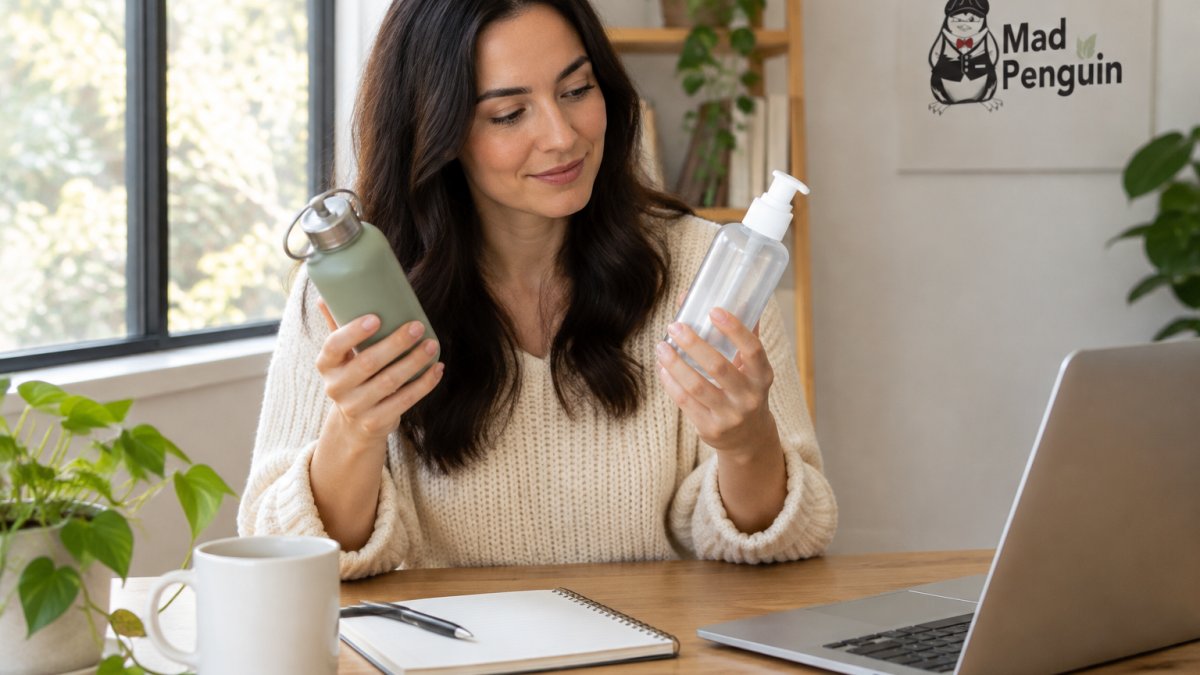
Most brands guess at their waste. A better path is a simple three-step roadmap: audit, choose, then measure. Each step builds on the last, and none requires a big budget. This roadmap is designed specifically for direct-to-consumer operations, where packaging decisions are tightly linked to fulfillment and end-of-life outcomes.
Step 1: Audit Your Packaging and Shipping Materials
Start by listing every component that leaves your warehouse. Weigh the box, the filler, the insert, the label, and the container. Note which parts are recyclable and which are not.
- Count how many pieces go into one order
- Flag any plastic that isn't post-consumer recycled
- Check whether your mailer is larger than it needs to be
- Measure the cube (length × width × height) of your most common order configuration to spot oversized packaging
A common mistake is skipping the shipping materials. A smaller box and lighter filler can cut material use fast.
Watch out: Don't assume your current packaging is optimized for dimensional weight. Carriers bill by dimensional weight, so an oversized box costs more to ship and uses more material. Resizing to fit your products snugly can reduce both waste and shipping costs.
Step 2: Choose Recyclable or Refillable Formats
Refillable packaging is one of the clearest ways to shrink beauty's footprint, as noted in APiCure's look at beauty's environmental impact. Glass and aluminum containers recycle well, and refill pods cut new plastic.
For a closer look at format options, see our guide to eco-friendly packaging in skincare. Prioritize:
- Single-material containers over mixed ones (e.g., a glass jar with an aluminum lid is easier to separate than a plastic pump with a metal spring)
- Refill systems for repeat buyers, with clear incentives to return the outer container
- Post-consumer recycled content where glass isn't practical, such as in caps and closures
When evaluating refills, consider the logistics: do you ship the refill in a separate mailer, or can it go in a standard envelope? The shipping footprint of the refill matters as much as the packaging itself.
Watch out: Refill systems can fail on hygiene if the outer container isn't designed for easy cleaning. Choose refill formats that allow customers to rinse or wipe the outer container without damaging the mechanism.
Step 3: Measure Impact and Adjust
You can't improve what you don't track. Set a baseline for packaging weight per order and track it monthly. Pair that with a waste reduction rate goal.
Waterless and low-waste formulations also help. A 2025 trends report recommends them to conserve resources (2025 Trends in Health & Beauty Sustainability). Lighter formulas mean smaller containers and fewer shipments.
To make measurement actionable, set a quarterly target for reducing packaging weight per order by a small percentage, and review progress with your fulfillment team.
Watch out: Don't rely on supplier claims about recyclability without verifying them against local recycling guidelines.
Here is the three-step roadmap the article lays out for DTC brands.
| Step | What to do | Key detail |
|---|---|---|
| Step 1: Audit | List and weigh every component that leaves your warehouse | Shipping materials are often the biggest blind spot |
| Step 1: Audit | Measure the cube of your most common order configuration | Spots oversized packaging and dimensional weight costs |
| Step 2: Choose | Pick single-material containers over mixed ones | Glass jar with aluminum lid is easier to separate |
| Step 2: Choose | Offer refill systems for repeat buyers | Benefit disappears if the refill pod uses as much plastic |
| Step 3: Measure | Set a baseline for packaging weight per order | Track monthly, segmented by product type |
| Step 3: Measure | Track return rate alongside packaging weight | Returns generate additional packaging and shipping waste |
Packaging End-of-Life and Recycling Realities for DTC Beauty
What happens after the box arrives decides much of the real impact. Many customers want to recycle but aren't sure how. Clear instructions raise the odds they do it right. But the bigger issue is design: if a package isn't designed for recyclability, no amount of instruction will keep it out of the trash. This section explains how to design for recyclability, account for pumps and mixed materials, and avoid overstating what consumers can recycle locally.
Design for Recyclability
Recyclability starts at the design stage. A package is more likely to be recycled if it is made of a single material and is easy to separate.
- Choose single-material containers where possible (e.g., all-glass jars with metal lids, or all-plastic bottles with matching caps)
- Avoid pumps and dispensers that mix plastic and metal unless they can be easily removed by the consumer
- Use paper-based inserts and void fill that can be recycled with the box
A common pattern is that brands use a recyclable primary container but then seal it in a plastic sleeve or add a plastic window to the box, which contaminates the recycling stream. If you need a window, consider using a paper-based alternative or eliminating it entirely.
Watch out: Don't assume that a package labeled "recyclable" will be accepted in all curbside programs. Recycling acceptance varies widely by municipality, and a package that is recyclable in one city may not be in another.
Pumps and Mixed Materials: The Hidden Barrier
Pumps are a particular challenge. A typical lotion pump contains a plastic housing, a metal spring, and a plastic dip tube. These components are difficult to separate, and many recycling facilities won't accept them. As a result, pumps often end up in landfill even when the bottle is recyclable. For DTC brands, this means that a product with a pump may have a higher environmental impact than a product in a simple squeeze tube, even if the bottle itself is made of recycled plastic.
- Offer pump-free formats where possible, such as squeeze tubes or dropper bottles
- If a pump is necessary, choose designs that can be easily disassembled by the consumer, and provide instructions
- Consider offering a take-back program for pumps, where customers can mail them back for proper recycling
Watch out: Take-back programs can be logistically complex and may not be cost-effective for small brands. Start with a pilot for your most popular product before scaling.
Avoid Overstating Recyclability
Greenwashing is a real risk. Terms like "eco-friendly" and "sustainable" are vague and can invite scrutiny from regulators and consumers. The Federal Trade Commission's Green Guides provide guidance on environmental marketing claims, including recyclability. A claim that a package is "recyclable" should be qualified if it's not recyclable in most communities.
- Use specific language: "bottle recyclable in curbside programs; pump not recyclable"
- Avoid terms like "eco-friendly" unless you can substantiate them
- Provide clear disposal instructions on the insert and on your website
For a full walkthrough, read our step-by-step guide to recycling beauty packaging. Honest labeling builds trust and keeps recyclable material out of the trash. At Mad Penguin Skincare, we care about how our packaging is handled at end of life. Visit our website to see how we put these principles into practice.
Building an Eco-Friendly Skincare Routine That Cuts Waste
An eco-friendly skincare routine starts with buying less and using what you have. Fewer products, refillable formats, and full use of each jar add up.
Try these habits:
- Choose multi-use products over single-purpose ones
- Finish a product before buying a replacement
- Recycle the container once it's empty
- Pick refills when they're available
For a practical plan, follow our guide to building a sustainable skincare routine. Small, steady choices beat one big overhaul.
How Mad Penguin Skincare Puts Low-Waste Beauty Into Practice
We keep our formulas clean and our packaging thoughtful. Our products are free from synthetic chemicals and harsh additives, and made for all skin types. That means one well-chosen product can do the work of several, a multitasking formula like our Night's Best Friend Overnight Repair Cream or the California Ocean Mineral Anti-Aging Moisturizer can replace several single-purpose jars on your shelf, cutting down on packaging and shipping in the process.


Curious why this matters? See why eco-friendly skin care is worth it. Our approach pairs effective results with a commitment to reducing environmental waste and pollution.
Start Your Low-Waste Skincare Switch with Mad Penguin
Switching to lower-waste skincare doesn't mean giving up results. Start with one product, use it fully, and recycle the container. Then add the next.
Browse our skincare bundles to build a routine that's kind to your skin and the planet. You get clean formulas, eco-friendly packaging, and results you can see.
Ready to cut waste from your routine? Mad Penguin Skincare offers natural, non-toxic formulas in eco-friendly packaging, made for all skin types. Shop our plant-based bundles and start your low-waste switch today.
Frequently Asked Questions
How wasteful is the beauty industry?
The beauty industry generates significant packaging waste, much of it plastic that is used once and discarded. Circular practices in cosmetics can help reduce emissions, pollution, and waste, and recycling, refilling, and reusing are commonly cited circular-economy steps. For DTC brands, the biggest lever is packaging design and fulfillment, because those choices determine what customers throw away.
How can beauty brands reduce packaging waste?
Start with a packaging audit: measure the weight of each component, then switch to refillable or reusable containers where possible, choose recycled materials, and cut unnecessary secondary packaging. Evaluating impacts from design through end-of-life is a useful approach. For DTC channels, right-size shipping boxes and use recyclable mailers. These tips for reducing waste in the beauty industry work best when brands set a baseline and track progress over time.
Are refillable skincare products better for the environment?
Refillable packaging can significantly reduce the beauty industry's ecological footprint, according to APiCure's analysis of beauty's environmental impact. A 2025 article by Haykal et al. lists refilling and reusing as core circular practices. The benefit depends on how customers use the refill system and how far refills travel. Brands should design refills that are easy to return or recycle and measure the actual waste diversion rather than assuming refills are always better.
How can consumers reduce waste in their skincare routines?
An eco-friendly skincare routine starts with buying fewer, multi-purpose products and using them fully. Choose refillable or recyclable packaging, rinse and recycle containers where accepted, and avoid products with unnecessary outer boxes. Waterless and low-waste formulations can help conserve resources. Mad Penguin Skincare offers natural, non-toxic products in eco-friendly packaging, so you can build a routine that supports your skin and reduces environmental waste and pollution.
