

Last Updated: November 17, 2026
Quick Summary
The 5 signs of toxic ingredients in your skincare are persistent redness and irritation after application, unexpected breakouts and clogged pores, dryness, flaking or a tight feeling, new allergic reactions or sensitivity, and a burning or stinging sensation. Stop the product and simplify your routine if these signs appear.
- A 2024 review linked roughly 88 chemicals across more than 73,000 cosmetic products to skin irritation, headaches, and dizziness.
- A 2026 Frontiers in Public Health review reported 64% of reported cosmetic products posed a chemical risk from unauthorized substances.
- Fragrance, preservatives, and certain UV filters top dermatologists' list of ingredients most likely to cause contact dermatitis.
- Ingredients are listed by concentration until 1%, so the first five ingredients tell you most of the formula.
- Patch test anything new behind your ear or on your inner arm for 48 hours before using it on your face.
Table of Contents
- 1. Persistent Redness and Irritation After Application
- 2. Unexpected Breakouts and Clogged Pores
- 3. Dryness, Flaking, or a Tight Feeling
- 4. New Allergic Reactions or Sensitivity
- 5. A Burning or Stinging Sensation
- Harmful Ingredients in Skin Care Products: What to Look For
- Ingredients to Avoid in Skincare, According to Dermatologists
- How to Read Skincare Ingredient Labels
- Frequently Asked Questions
1. Persistent Redness and Irritation After Application
Redness that lingers after you apply a product can be a sign that an ingredient is irritating your skin. It usually means your skin is reacting to an ingredient rather than simply adjusting to a new formula.
A 2024 review indexed in the PubMed Central review of cosmetic chemical health effects identified roughly 88 chemicals across more than 73,000 cosmetic products linked to skin irritation, headaches, and dizziness. That is a wide net. Not every flush is dangerous, but a consistent pattern is your skin telling you something.
Here is how we would read it. If redness fades fast, it is likely a temporary response to exfoliation or a new active. If redness persists, spreads, or comes with warmth, stop the product and simplify your routine to a gentle cleanser and moisturizer for a week. Our California Ocean Mineral Anti-Aging Moisturizer is a simple hydrating step for that reset period.
2. Unexpected Breakouts and Clogged Pores
Breakouts that appear in a new pattern after you start a product are a strong signal, especially along the jaw, forehead, or cheeks where you applied it. This is not the same as purging from a retinoid, which tends to settle within a few weeks.
Heavy occlusive ingredients and certain fragrance components can contribute to clogged pores in some people. If you are breaking out in the same spots every time you use a specific product, that product may be a contributing factor worth reviewing.
Our L.A. Hibiscus natural face scrub uses hibiscus, a botanical rich in natural acids, to help lift dull cells and unclog pores gently. Exfoliating once or twice a week is usually enough. More than that tends to irritate rather than clear.
3. Dryness, Flaking, or a Tight Feeling
A tight, squeaky-clean feeling after washing is not a good sign. It usually means the product stripped your skin barrier faster than your skin could recover.
Flaking that appears without a change in weather or routine can sometimes be linked to a product ingredient. Skin sensitivity of this kind builds quietly. You may use a product for weeks before the flaking starts, which makes the culprit harder to spot. Keep a simple note of what you started using in the prior month.
If your skin feels tight and rough, switch to a richer nighttime formula while it recovers. Our Night's Best Friend Overnight Repair Cream is built around botanical oils and vitamins to replenish moisture overnight, when skin does most of its repair work.
4. New Allergic Reactions or Sensitivity
An allergic reaction can show up as itching, hives, swelling, or a rash that was not there before. It can develop after months of using a product with no issue, which is why people are often surprised.
A 2026 review in Frontiers in Public Health on restricted cosmetic substances reported that 64% of reported cosmetic products posed a chemical risk because they contained unauthorized substances, while 14% exceeded authorized limits. That is a reminder that label accuracy matters, and that repeated exposure to a restricted ingredient is a real pathway to sensitization.
If you suspect a reaction, stop the product, photograph the area, and give your skin two weeks of bland, fragrance-free care. If it spreads or affects your breathing, seek medical help immediately.
5. A Burning or Stinging Sensation
Stinging on application is never a normal part of a good routine. A brief tingle from an active is one thing. Burning that makes you want to wash your face off is another.
Common triggers include fragrance, alcohol-heavy formulas, and formaldehyde-releasing preservatives. Consumer Reports' guide to concerning cosmetics ingredients flags phthalates, parabens, formaldehyde-releasing preservatives, PFAS, and coal tar as ingredient groups worth watching. Fragrance can be a common cause of contact dermatitis, and the word "fragrance" on a label may not list its components.
If your skin is burning right now, read our guide on how to soothe irritated facial skin for a five-step recovery routine you can start tonight.
Harmful Ingredients in Skin Care Products: What to Look For
The most useful filter is not a list of scary chemicals, it is a shortlist of ingredient families that show up again and again in reactions. Here is where we would start.
- Fragrance and "parfum" - an umbrella term that can contain dozens of undisclosed compounds
- Parabens - preservatives such as methylparaben and propylparaben
- Phthalates - often hidden inside fragrance blends
- Formaldehyde-releasing preservatives - look for DMDM hydantoin, diazolidinyl urea, and quaternium-15
- PFAS - used in some long-wear and water-resistant formulas
- Coal tar dyes - listed as CI followed by a number
- BHA and BHT - antioxidants that can irritate sensitive skin
- Triclosan and benzophenone - antibacterial and UV-filtering compounds
The FDA maintains a list of prohibited and restricted ingredients in cosmetics, including bithionol, which is prohibited because it may cause photocontact sensitization. That page is a useful reality check: some ingredients are restricted for good reason, and most are not.
If you want a practical walkthrough, our article on how to identify non-toxic skincare ingredients breaks down what to scan for first. For a deeper look at specific offenders, read our guide to common endocrine disruptors in beauty products.
Ingredients to Avoid in Skincare, According to Dermatologists
Dermatologists tend to focus on the ingredients most likely to cause contact dermatitis, not the longest list of possible concerns. Fragrance, preservatives, and certain UV filters top that list. If you have sensitive skin, those three categories are where to start.
But here is the part most guides get wrong. The presence of a chemical does not make a product harmful. Many chemicals in cosmetics pose little or no risk, while a smaller number have raised health concerns. Dose, route, and frequency of exposure all matter. A rinse-off cleanser and a leave-on serum are not the same exposure.
That is why dermatologists often separate established irritation and allergy risks from emerging, disputed, or exposure-dependent concerns. Fragrance and preservatives have decades of patch-test data behind them; they are the most reliable predictors of a reaction.
Product type matters too. Leave-on products like serums, moisturizers, and eye creams stay in contact with your skin for hours, so the concentration and the application area matter more. Rinse-off products like cleansers and scrubs have seconds of contact, which lowers exposure for most ingredients.
That is why we formulate Mad Penguin Skincare around clean, non-toxic ingredients free from synthetic chemicals and harsh additives, and why we publish what goes into each product rather than leaning on the word "clean" alone. Our Goodbye Puffy Eyes eye cream is a good example: a lightweight antioxidant formula for the delicate eye area, made with natural ingredients and vegan and cruelty-free.
How to Read Skincare Ingredient Labels
Reading a label properly takes about 30 seconds once you know the order of operations. Ingredients are listed by concentration, from highest to lowest, until you reach 1%, after which the order is up to the manufacturer. That means the first five ingredients tell you most of what you need to know about the bulk of the formula.
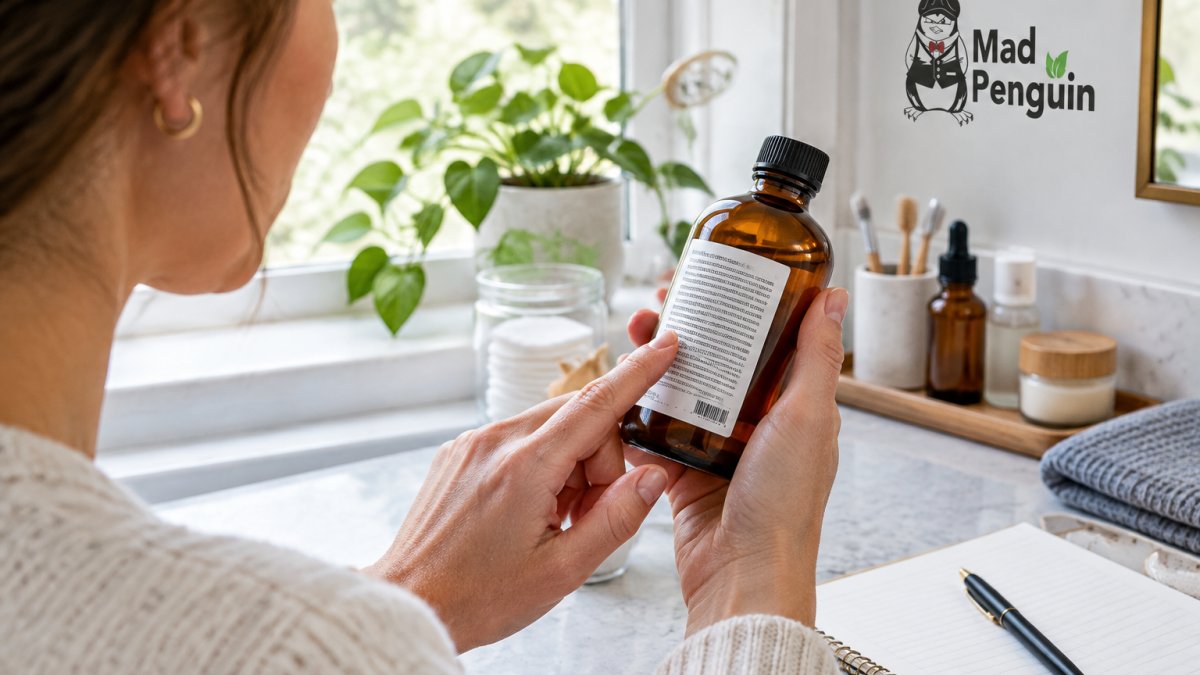
Here is a repeatable method you can use on any product, whether it is a leave-on serum or a rinse-off cleanser:
- Check the first five ingredients. These make up the bulk of the formula. If fragrance or alcohol sits near the top, that tells you a lot. In a leave-on product, those top ingredients stay on your skin for hours; in a rinse-off product, contact time is seconds. The same ingredient can matter more or less depending on how you use it.
- Scan for the word "fragrance" or "parfum." If you have sensitive skin, treat it as a stop sign. Fragrance is the single most common cause of contact dermatitis in cosmetics, and it hides behind that one word without listing its components. Some brands disclose specific fragrance allergens like limonene or linalool, but most do not.
- Look for formaldehyde releasers. DMDM hydantoin, diazolidinyl urea, imidazolidinyl urea, and quaternium-15 are the common ones. These preservatives slowly release small amounts of formaldehyde over time to keep the product free of mold and bacteria. For most people at typical exposure levels, the amount is low; for people with a known formaldehyde allergy, they are a common trigger.
- Check for "CI" followed by a number. These are colorants. Coal tar dyes are worth avoiding if you react easily, but not every CI number is a coal tar dye, some are mineral pigments. The label alone will not always tell you which is which.
- Compare against a shortlist. Keep a note on your phone of the five or six ingredients that have caused problems for you. Alternate names matter here: "fragrance" can appear as "parfum," and "methylparaben" may be listed alongside "propylparaben" or "butylparaben." If you have reacted to one paraben, watch for the whole family.
- Patch test anything new. Apply a small amount behind your ear or on your inner arm for 48 hours before using it on your face. This is especially important with leave-on products, where the ingredient stays in contact with your skin far longer than a cleanser you rinse off.
Watch out: a "clean" or "non-toxic" claim on the front of the package is not a regulated term, so it does not tell you what is actually inside. The ingredient list on the back is the only part you can verify.
If you want to go further, our non-toxic skincare guide for sensitive skin covers how to build a routine around ingredients your skin tolerates. For a deeper look at specific offenders, read our guide to common endocrine disruptors in beauty products.
| Concerning Ingredient | Why It's Flagged | What We Use Instead |
|---|---|---|
| Synthetic fragrance | Common cause of contact dermatitis | Botanical ingredients, no added fragrance |
| Parabens | Preservative linked to sensitivity concerns | Naturally derived preservation |
| Formaldehyde releasers | Slow-release irritants | Free from unnecessary harsh chemicals |
| Harsh surfactants | Strip the skin barrier | Gentle, plant-based cleansing |
| Coal tar dyes | Colorants that can trigger reactions | No synthetic colorants |
Frequently Asked Questions
What are the top ingredients to avoid in skincare products?
Common ingredients to watch for include parabens, phthalates, formaldehyde-releasing preservatives, and synthetic fragrances. The FDA also lists specific prohibited ingredients like bithionol. Some reviews have discussed cosmetic chemicals linked to health effects like skin irritation and headaches. Checking labels for these names is a key step in choosing safer products.
How can you tell if your skincare is toxic?
Look for signs like persistent redness, unexpected breakouts, or a burning sensation after use. These can indicate irritation from harsh ingredients. Also, examine the ingredient list. A 2026 review found that 64% of reported cosmetic products contained unauthorized substances. If a product causes a reaction, stop using it and consult a dermatologist. Using a harmful skincare ingredients checker can also help identify problematic components.
Are fragrance and preservatives in skincare always harmful?
No, they are not always harmful. Many chemicals in cosmetics pose little or no risk. However, some people are sensitive to specific fragrances or preservatives like parabens. If you have sensitive skin, choosing fragrance-free products or those with safer preservative systems can reduce the risk of irritation. It's about identifying your triggers and reading labels carefully.
What should you do if a skincare product causes a reaction?
Stop using the product immediately. Gently wash the area with lukewarm water and a mild cleanser. Avoid applying other products to the irritated area. If the reaction is severe or doesn't improve, consult a healthcare professional. To find a safer alternative, look for products with simple, non-toxic ingredient lists, like those from Mad Penguin Skincare, which are formulated with natural, non-toxic ingredients.
